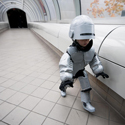
Our baby boy is walking; at least, he's doing that ten-step creaky-mummy-emerging-from-the-tomb toddle from mom to dad and dad to mom and sometimes dad to sister or sister to dog. With this new mobility comes a new sense of dread: just when I had grown comfortable thwarting him and his ground-slapping crawl from causing too much damage around the house, he's working on this stealthy bipedal ambulation. Next it will be the grappling hook and the throwing star. I'm screwed.
The kids and I spent part of the afternoon yesterday going through the old DV tapes looking for footage of Juniper's first steps. We didn't find it, but we watched a lot of tape of me ordering my daughter to dance in this desperate and slightly-effeminate voice. I half expect her to turn towards the camera each time and say, "Dude, I am NOT your monkey. Stop telling me to dance." But what comes out of her mouth instead is complete and total gibberish. Somehow, though, the dude with the slightly-effeminate voice is conversing with her and actually responding to all that jibber-jabber. It was like watching a younger version of yourself deftly haggling over the price of red bell peppers with a street vendor in Budapest, except you don't remember knowing any Hungarian. To put it even more simply, it was like watching Han Solo have a conversation with Chewbacca.
I look at my toddling son, not yet having uttered a single word. We still have to go through all that with him, I think. I'd better brush up on my Wookiee.
I remember being so excited watching her language skills evolve into something tangible. I go back and read old posts on this site and sometimes cringe at the things I've put between quotation marks for her. Did she really talk like an Indian sidekick in an old cowboy movie? The video confirms it. As awesome as it was watching her learn to speak, I can't help but appreciate this articulate nearly-four-year-old creature we have now who can communicate in more than yawps and exaggerated groans.
For dinner yesterday I made her spaghetti and meatballs from scratch. She told me she didn't want spaghetti and meatballs but I made it for her anyways and let her help with the sauce. When I finally brought the plate over to the table, I sat down with her and started singing "On Top of Spaghetti." The line "I lost my poor meatball" threw her into hysterics. Between sobs, actual plump tears coursed down her reddened cheeks. "What?" I asked. "What is wrong?"
"I don't like that song, pops!" She yelled. I stopped singing.
After she was about half done with her meal, I started humming it again. I don't know what's wrong with me: sometimes I just can't help myself. She immediately commenced with the wailing and blubbering again. I looked at my wife. I think this is hilarious, too, her eyes and clenched jaw told me. When Wood pretended to sneeze on her meatballs, Juniper practically went into convulsions. "Why don't you like the song, kiddo?" I asked.
"Because my brain doesn't like it when things are 'poor' or when things get lost."
We tried logic. We tried reason. It was just a meatball. It didn't matter. She's a kid. Even if she's able to make a perfect sentence, that doesn't mean she has to make any sense.
Every day it seems like we watch the world form itself anew in her eyes. Synapses crackle, patterns emerge. Cresting Lone Mountain the other night on our way home from the Haight, the fullish moon emerges from its spot low on the eastern horizon and she is in the crook of my arm, pointing at the moon between some blunt apartments and St. Ignatius, and she says "ball" in a voice that is startlingly sure of itself.
That's right Juniper, it is a ball. So is the circle I draw in the condensation obscuring our favorite window every morning when we look out onto the quiet street. Just like the globe on the shelf at the coffee shop, and the stemless cherries in the last book we read before I let you turn off the light at night. Sometimes you see a ball when we're out walking somewhere, and I can't tell what you're talking about, your eyes filled with whole worlds I cannot see, though you still find words to define patterns; describe memories; create metaphors.
The barbaric yawps of your infancy have given way to words. No longer content to passively howl, begging for warmth and attention, you are finally able to control your world a little by naming the things you know. You coyly grin when you say something that makes sense, seeking acknowledgement and hugs.
The Greeks had a word for those who could not speak Greek: βαρβαρος (barbaros). It is often said the ancients listened to the languages of other tribes dragging their wares for trade from beyond the Caucuses and could discern little but the sound "bar bar." It came to mean "foreigner" to the Greeks, and came to us later as barbarian. But it all boils down to the Proto-Indo-European root "ba ba," a word "imitative of unarticulated speech," and also the root of our word baby. And babble. The Greeks were snobs. They believed anyone who didn't use their alphabet spoke like an infant. A word itself that comes down to us from the Latin infans, which means "incapable of speech."
Roman Jakobson once wrote that the sounds all babies first make to form words across all cultures arise from nursing, which is often "accompanied by a slight nasal murmur, the only phonation which can be produced when the lips are pressed to mother's breast or to feeding bottle and the mouth is full." With time, that phonation is repeated and expanded as a manifestation of any desire. I think that makes sense considering the frustrating early declarations and demands that Juniper articulated as mmm-mmm-mmmms and nnn-nnn-nns. But now we are in new territory; Juniper has officially moved even beyond the bilabial plosive. Desire does not fully explain the tangible pride she gets from expressive speech, which seems to me less driven by desire than by self realization. Juniper has recently learned the word, "eye" and I can't help but wonder about its homonyms, both for affirmation and identity.
New words fall neatly into place in her burgeoning lexicon almost every day. Light. Hi. Bubble. Nouns make way for prepositions (up) which she also manages to use as an adverb, an adjective, and an imperative verb. "Up!" she barks at 6:40 a.m., seated between Wood and I in bed, banging her tiny fists against our bellies. "Up!" she orders, with her hands reaching into the air. "Up!" she exclaims when we climb stairs. Before we bring her to our bed, we hear her in her crib talking to herself, running through the list of words she knows like a college sophomore before a French quiz. She wakes to muted daylight and the desire to speak.
It is so exciting to watch Juniper brush aside the confusion and chaos of infancy. What a responsibility we have, in teaching her to communicate, in helping her to overcome frustration and express her desires, emotions, fears, and hopes. After so many months of speculating, I can't explain the joy that speech provides as a window into her untapped little mind.
But it is terribly frightening also. It is easy to gauge the progress of her expressive speech, but her receptive comprehension is more elusive. What does she understand about what we say? When Wood and I argue and she watches us, how much of the timbre and strange levity in my voice does she pick up as anger? Sometimes we'll say a word that sounds like frog and she'll dart her tongue out rapidly like we have taught her to do. If we say horse she bucks her body like a redneck on a mechanical bull. What an awesome responsibility it is, suddenly, to speak.
She is still very young, and there is so far to go. And yet the limits of her speech also show just how much she knows. The moon is a ball. The sun is a light. She sometimes calls our window dada because it is through that glass we wave goodbye each morning, over and over until I've crossed the street and disappeared, and it is through that glass that she watches, waiting for me to walk home from work in the evening, waving to her as I approach.
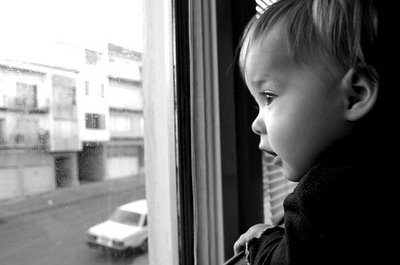
Juniper is pointing at things now, too. She sees the wedding photo of Wood and I on the wall and she points to it and says, dad. In my arms, her face and eyes close to mine, she points to my painting of Charlie Chaplin and says, dad. She points to Wood's autographed photo of Harry Truman and says dad. Her world is full of father figures, it seems. Either that or she has no problem confusing me with guys who have hitlerstaches or no hair.
One of the female providers at Juniper's daycare told me that yesterday the guy who takes care of her asked her where her daddy was and she looked towards the door, but then the woman also told me in her pidgen English that Juniper calls him dada and he says, No, I'm not your dada. No, not me. The guy himself has enough sense not to tell me this, but he can't keep this Chinese broad he works with from breaking my heart.
When I get home from work Wood sets her down by the door to the hallway where I come in soaked from the rain, where I slip off my wet shoes and drop the mail and hold out my arms for her as she crawls down the hallway to me, stopping at my holey socks and pulling herself up by my pantlegs, pushing against my shins before wobbling backwards with her arms in the air, begging to be picked up. Her mother says, daddy's home and she looks at me and mumbles dada before burying her face in my wet shoulder, a shy girl suddenly. I hug her and put my lips against her neck and bounce around the apartment while she laughs and giggles in a voice that hints at what she will talk like when she is a big girl, when's she's too big to hold like this or toss in the air and swing upside-down. I try to squeeze as much of that voice out as I can on nights like tonight with such little time before she has to go to bed, before the nightly battle over sleep challenges me to remember the sweetness in her eyes when she first saw me home, the crinkle in her nose as she crawled across the floor to greet me.
She hasn't said mama yet, but she can say ma when she puts her lips against the back of her hand and kisses it, MMMaaa! She kisses the porcelain of the bathtub and says, MMMaaa! She kisses my hairy belly and says, MMMaaa! She imitates you when you do it on her cheek, on her forehead. She has learned to wave goodbye. She sings when you take her socks off.
In the mornings, after Wood brings her to our bed for the first feeding of the day, and after she wakes from it and stares at us in astonishment that we would sleep like such shrews hiding from the cusp of the morning, she reaches out for my face and I feel her fingers on my nose, across my eyes and into my mouth, and dadadadadadadadada is the first sound I remember hearing every day. Sometimes we wake to find her making raspberries with her lips. It is getting dark earlier and earlier in San Francisco these days, but still, each evening I call Wood when I get off the bus and when I turn the corner, across the avenue, I see Junebug's face in our window, peering for me in the darkness. By the time I am halfway across the avenue she has found me, and I see her fists banging up and down on the couch and her mother's natural smile above her tells me all I need to know about what Junebug's moving lips are saying. I stand down there, below her face in the window, and I smile and wave and mouth words to her. I would stand there in any kind of rain.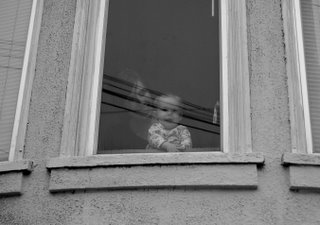
These are just little things, I know, like the curious look of mistrust she gives me when I run a comb through her hair (it's getting longer), or the way she holds on to her mother like a little naked koala when she is fresh from the bath. But they are the little things that all together overcome you with the sensation that this is all so worth it, that this is the best thing in the world you could be doing, that the love you feel for this little person is more powerful than any words you could possibly use in a fruitless effort to contain it.