Her room has become a place of menacing noises. In the half-darkness imposed by the security lights outside, I come in and she off-handedly tells me she no longer wants a dog, but a mouse instead. Half an hour later she is still awake, afraid. Now there are mice scurrying around her room. The sky at night is always orange. Even the empty prairies of Detroit are lit by streetlights that have not yet broken or been stripped of their copper wire, a hopeful remnant grid of utilities that belie the existence of any actual neighborhood. Darkness is never her bedtime fear, but always noise. When I ask her about any bad dream, it was inevitably a "loud, loud noise," and when pressed she'll imitate a siren, or a car alarm. Whenever one of us leaves the struggle in her room at bedtime, the chorus starts behind the door, and then the other one goes up a few minutes later to try their luck. This time it might be a demand for one more song, or a tree that is scratching her window. We take turns, like blacksmiths at an anvil, trying to calm her with stories of fairies and pandas, old songs, and long, whispered shhhhhhs while stroking her hair. The whimpering starts again whenever we shift, knowing too well that our every motion is bent towards the door. After an hour or so of this we might get some silence, and then sigh, "She's slept through the night for almost a year," Wood will say. "Why this now?"
"We've grown soft," I'll reply. "Remember how bad it was?"
But then the wailing resumes, and from that fleeting moment of solidarity, all that's left is frustration. And because there is nowhere else left to turn, we turn on each other. When the kid is finally asleep, Wood goes to bed without speaking to me. So I sit alone listening to the same song over and over, too angry to do anything. Sometimes I'm sure I have no idea what I'm doing, no lodestar here in the never-darkness of Detroit. I fear that am fucking her up and failing both of them in ways I cannot even imagine. I am no good. I suddenly crave untethered selfishness. I don't want to be responsible for anyone. I don't want to go back into that room. I don't want to tell another story. I don't want to fight with my wife again tonight. I don't want to end this with some pithy observation that despite all this, parenthood is worth it. Not today. Because even if that is true, sometimes it can be so hard, too. And I need to acknowledge how terrified I am of going through it all again.
Our couch was the first piece of real furniture I ever purchased. Through law school we used hand-me-downs, and during those months I lived in the quad, I used an actual blow-up couch my parents gave me as a birthday present when I turned 22, dense and heavy in a 12" by 16" cardboard box. When I got my signing bonus and signed a lease for an apartment in San Francisco, I decided to buy a couch that didn't (1) smell like Nixon-era onions; or (2) lose several pounds of air pressure when someone's ass occupied it for more than three minutes. As luck would have it, the fanciest furniture dealer in SOMA was having its annual floor-sample blow out that weekend, so Wood and I walked around the sale shocked that furniture that had cost so much to begin with could still cost so much when marked down 75 percent. But in the very back of the store we found a gray Flexform sofa that we both loved, originally $5700, marked down to $1250. As I paid for it, the impeccable little saleswoman informed us that the delivery charge was $300. "Fuck that!" I said. "I'll tie it to my rear bumper and drag it through the streets before I pay a $300 delivery charge." She shrugged; she was one of that species of high-end salespeople who couldn't give less of a shit that you exist.
As I stood there pondering how many funyun-flavored couches I could buy at the Salvation Army for $300, I decided to walk over to the nearest U-Haul agency. It was a Saturday, so I had to wait four hours, standing around with all these Mexican day laborers before a truck became available. When we finally showed up to pick up the couch, everyone watched us as though they had never before seen anyone carry their own furniture. "They think we're poor," Wood whispered over our new couch as we maneuvered it through a selection of Artemide lighting. "Well, if they don't want us buying their shit they shouldn't have sales," I said. We got the couch home for less than $35.
In the summer of 2006, when we were preparing to move away from San Francisco, Wood suggested we sell the couch. I looked at it and grew hopelessly sentimental. This was the couch where years earlier, on so many Sunday nights, we'd fallen asleep early in each other's arms before waking at eleven to drive to the airport for the red-eye flights that took Wood away from me for weeks or months that year. The very day we bought the couch turned into one such night, in an empty apartment, a thrift-store television on the floor, a few DVDs, a pile of clothes waiting for hangers, and all I could focus on was how the only thing that has ever made me feel at home was hours away from leaving me.
Even after she moved out west, and we had a full bed, we would fall asleep on that couch watching crap on network television. We had a certain way of sleeping on it, a seasoned leg-and-arm tetris that allowed us to be comfortable even in such a small space. We'd been sharing a twin bed for years, ever since Wood moved into a shitty apartment her junior year and found a moldy old twin mattress and boxspring in her room. "I'll put a sheet over it," she said. I've seen mattresses on the curb after long, hard rains that grossed me out less, but I was sleeping with the hottest girl I had ever seen, so I couldn't complain. We always slept on twins. Until recently we've never had rooms big enough for anything else.
Every home needs a real couch, my wife believes---not a sofa or a loveseat---a couch you can stretch out and sleep on. In San Francisco, we positioned ours by the bay windows that overlooked the corner of Cabrillo and 2nd Ave, so we could sit there and watch souped-up 1991 Honda civics gun it from stop sign to stop sign out through the avenues. Some nights we would fall asleep on it only to be roused at 3:00 a.m. by "Ace," the homeless guy in a top hat who walked up and down our street fighting with his "slut whore-bag-cunt" of a girlfriend, or sometimes we'd be woken at dawn by the old Russian lady across the street beating her carpets on the fire escape. In the fall of 2004, with this daughter of ours expanding my wife's uterus, I lost some crucial real estate on the couch and could no longer fall asleep there. When Juniper was born, the couch became one of her favorite places. It was where we would play in the early mornings before I had to go to work, and it was where she would sit and watch out the windows for me to walk up the avenue. It was this couch where we retreated so many of those nights trying to get her to sleep, her crib in our bedroom, when any silence from her was suddenly as precious as those hours we'd once had on that couch before Wood had to catch a red eye.
I have some sympathy for compulsive hoarders; I understand illogical attachment to objects that incite memories. I don't get the people who keep old newspapers, but I know the unease in the faces of those people forced to throw away their old things on HGTV, the love for those small intimacies in an object's history. When we left San Francisco, we left the "home" where Juniper had taken her first steps, spoken her first words, done all those other treasured things that happen in the first eighteen months. We had to say goodbye to those walls, but I'd be damned if I was going to let some silly freight charges get in the way of us keeping that couch. It ended up costing less to ship across the country than that snooty store wanted to charge to cart it across San Francisco when it was still new, unstained by breastmilk, untrammeled by toddler feet. It's still here with us, and for over a year nearly every night I've fallen asleep there against the warmth of my wife, against my will to get things done. A vortex, she calls it, consuming the most productive part of my evening time, distracting me from all the things I'm sure I need to do.
But now, again, my position on the couch has eroded away, the wombling and his mother need it all to themselves. This is it, I think: the last trimester is almost here, the last chance to spend these hours in some pursuit other than the pure delirium of sleep, or the inevitable exhaustion of his coming infancy. Soon he will be here. I'd better get some things done.
Juniper woke up this morning at 5:20 a.m. Wood woke with a migraine. I can't put into words how annoying it is to have to wake up at 5:20 a.m. because your kid thinks it's a downright bully time to make you read her Runaway Bunny six times in a row, primarily because Mr. Nice Guy has already described it so perfectly:
"so the kid woke up at 5:30 this morning. sometimes she does this. other times she sleeps till 6:30. the raw power of that single 60 minutes is astonishing to me. the hour between 5:30 and 6:30 has such magical attributes that if you sleep during it, you wake up refreshed. if you don't, you wake up feeling like someone has crapped in your mouth."
He then goes on to describe an early-morning Brooklyn encounter nearly as disturbing as that time Juniper and I stumbled across two pantsless homeless guys distracted away from their shopping cart caravans just long enough to reenact the "piggy" scene from Deliverance in the woods of Golden Gate Park. Read it.
I have a new post up at the Blogfathers.
And as long as I'm just linking today, check out shisomama: this lady makes great collages daily, her kid's name is Otis and he has a haircut so hip I tried to explain it to the chick who charges me $70 every couple months to make me look like I perpetually just crawled out of bed. Clearly, this is a blog I was meant to love.
Oh, and I'm cooking up something big for tomorrow hopefully.
Guess who has slept through the night with nary a peep, from 7:30 p.m. to 6:15 a.m. the last two nights?
Not the snoring mother-in-law; not Wood or I (who wake every hour wondering if a burglar with a striped shirt and a black lone ranger mask has crept up a ladder and stolen our baby).
Wood is convinced that if I write this, it will "jinx" us. I tell her not to use that word, that it's politically incorrect, like saying "I got gyped" or "he jewed me down." I have no idea what I am talking about though. I'm just too overjoyed and well-rested to keep quiet.
 We lived in a little apartment in the city that looked out across the street over the park to Sutro Tower. In the street there flowed rain and water from the guy who washes his P.T. Cruiser every day, and the water was filmy and prismatic and slow in the gutters. Cars went down by the apartment and down the street and the noise they made echoed in the living room. Garbage trucks and streetcleaning trucks came every day in the early morning, emptying the burdened curbs and filling the apartment with noise. The living room had six windows and as soon as the sun rose the room was filled with light and noise.
[fuck: I can't write this in bad faux-Hemingway. I'll just have to go with better-than-average Geraldo]
When we first reported from the sleep front, we were optimistic. We were examining and weighing the different battleplans offered by our joint chiefs of staff, Weissbluth and Sears. It was still early in the war, and our optimism carried us through dozens of nights of waking and screaming, waking and screaming, hour after hour. "It will be over soon," we told ourselves. "She won't be like this forever. Eventually she'll sleep through the night."
She never did; it became clear that unless we took up different tactics, the battle was going to be one long hard slog. Once we were at our wits end, we took a shot using Dr. Marc Weissbluth and Dr. Richard Ferber's "cry it out method." Juniper cried, alright, but she didn't really get the good doctors' "it out" part. She would cry for hours. It didn't work.
We have left a trail of experts behind us, experts whose advice just didn't work in the trenches. Weissbluth. Ferber. Sears. Michel "Dr. Judd" Cohen. Tracey "the Baby Whisperer" Hogg. We were desperate. One night she'd sleep great, the next lousy. In Rumsfeldian terms, we lacked the metrics to know if we were winning or losing the global war on sleep deprivation. Everything stagnated; nothing worked.
Then, Wood discovered Moxie. She's no fancypants pediatrician, she's just a cool blogger chick whose sleep discussions on Ask Moxie gave Wood a clear, more balanced perspective on infant sleep, and for months Moxie's sensible approach allowed us to work with Juniper's sleep in its natural state of flux; the war became one of attrition. A few weeks ago, Juniper wouldn't go back to sleep despite any amount of comforting, so we decided it might be time to try crying again. Rather than follow one asshole pediatrician's cockamamie theory de rigueur, we have taken the path of least resistance. And for the most part it has worked.
We are happy to report that at long last the enemy has shown weakness. She is now "sleeping through the night" because we retreated to a position of strength: the living room floor. We are sleeping on a lumpy fold-out mattress, entrenched with the dust bunnies while she sleeps in the luxury of her crib with the whole bedroom to herself. We're no longer in there to wake her up with every cough, sneeze, or rustle of the sheets at 3:30 in the morning, causing her to stand up and howl at us like a wounded emu until we pick her up. And she's sleeping. We wake up at dawn with the intense light from the living room windows and the noise of the garbage trucks and streetcleaners, but waking to the dawn and a sleeping child is a blessing after a full night of uninterrupted sleep.
Our strategy has been to put her to bed after some time with the booboobs that leaves her in milk-induced euphoric sleepitude, and then if she wakes up we Ferberishly let her whimper until she goes back to sleep on her own. Without us in the room, it usually works. We have had a week of good sleep, and last night when we put her to bed I was ready to put on a flight suit and land on an aircraft carrier to declare Mission Accomplished.
But our enemy is crafty, and understands how to exploit our greatest weakness. Yesterday Juniper had what Wood called her "cutest and sweetest day ever." And I can attest that the last few hours were indeed just that. We played with her Schleich animals, giggled in the tub, and she sat calm and silent in my lap while I read her seven books before bedtime. She even gave me a real hug and a kiss goodnight. Then at about 1:30 a.m. she woke and started crying, and by the timbre of her bellowing I could tell she was standing up. That was not good. Half an hour later her yowling was stronger than ever, and choked by tears. Wood was lying next to me in fitful frustration, ready to pull her hair out. Ten minutes later, with Juniper still crying, I went into the bedroom and picked her up. She was shaking. Her face glistened in the light that streamed in from the door I had opened. Choking and sobbing she threw her head against my chest and wailed. She was mad at me, and she was letting me know. She felt wounded. I wanted to smash Michel Cohen's smug face for telling me that "crying it out" doesn't affect her. I would have thrown Richard Ferber to wild dogs. I could not calm her down. After a few minutes of this punishment, her sleepy mother entered, lifted up her shirt and let Juniper rest her mouth on the boob. The sobbing stopped. She instantly fell asleep, imprisoning poor Wood in that position until she was asleep enough to lay back down in her crib, where she whimpered herself to a sleep that lasted the rest of the night.
And now, with Juniper reasserting a position of strength, drawing us out of our trench and mowing us down like a Messerschmidt, her reinforcements have arrived. Wood's mother is here for one of her patented "middle-aged-woman-sleeping-on-Dutch's-living-room-floor" weeks. Like Lord Cornwallis eyeing the approach of the French fleet at Yorktown, an imminent sense of defeat rests woefully in our bellies. We have a friend whose mother-in-law visited from Paris after she and her husband spent a month sleep training their daughter. The first night she sat there white knuckled while the baby cried in the next room, and despite strict orders not to, she rushed into the bedroom and comforted her. This went on night after night, and that month's worth of sleep training unraveled in a matter of days. Wood's mother knows better than to do that; if she tries it she'll be sleeping in a cardboard box on Larkin Street tomorrow night. But still, with her snoring on our living room floor, we have no option but to return to our bed.
We'll see what happens, but by now we're like Caesar's grizzled veterans: we know we can take whatever comes at us. What have we learned? The only advice worth listening to is advice that doesn't purport some superior knowledge of what will work with your child. Babies have their own personalities that can vary significantly from the statistical mean. It just seems to make the most sense to work with your own baby rather than the baby that only exists in some pediatrician's head.
On Monday I heard a story on NPR about the monks of the Carthusian order. A guy I went to law school with used to tell a corny story about a few years he spent as a monk in Colorado in a beautiful monastery filled with marble floors and golden fixtures where he dined on lavish meals and quaffed mightily from the monastery's own store of homemade wine and brew. "If this is poverty," he claims to have said. "Bring on chastity!"
Well, that was obviously not a Carthusian monastery. The Carthusians all live silent, solitary lives in their cells and have very little contact with their fellow monks. They do sometimes eat together, but don't talk. When they do talk, they only speak in Latin. They always wear heavy cowls and uncomfortable hairshirts. These guys pray. All day long.
So they spend their days in solitude, retire for bed at about 6:30 p.m., and are roused from their sleep at midnight to participate in the matins and lauds in the chapel, where for two or more hours they will do some late-night chanting. How does a monk who is not allowed to have a watch or an alarm clock get out of bed every night at midnight? Well one particularly responsible monk is allowed to keep a wind-up alarm clock, which he sets for midnight every night. Then he goes around from cell to cell, and rings a big-ass bell that hangs above every monk's head while he is sleeping. The roused monk must then rap his hand on a board to acknowledge that he is awake, then throws on his robes and hauls ass to the chapel. This very responsible monk is known as the excitator (Latin: "one who rouses"). He returns at 5:30 in the morning to wake them for their days.
Well, after two weeks on the road with Juniper, our trusty little excitator (who has woken up every ten minutes at night for the last five days) I think Wood and I both would gladly sign ourselves over to the cruelest Abbot of the cruelest Carthusian Charterhouse just so we could get some fucking sleep.
The human body, materially considered, is a beautiful piece of mechanism, consisting of many parts, each one performing its own vital function irrespectively of the others, and yet dependent for its vitality upon the harmony and health of the whole. It is, to a certain extent, like a watch, which, when once wound up and set in motion, will continue its function of recording true time only so long as every wheel, spring, and lever performs its allotted duty, or till it has run or been broken down. 
For much of a young man's life, the body ticks away without so much has a thought to its various gears and mechanisms. However, once a man becomes a father, his body suffers in untold and often unacknowledged ways. For children, despite their reputation as good-natured and inherently cute and kind, can, on occasion, be ghastly, tiny hellions who inflict such drastic violence and injury that if one were to do a survey of the injured at any local hospital and learn the true source of all of the poked-out eyes and sore backs and bloody nipples one would be forced to conclude that the children of our dear nation are more dangerous to our collective well-being than all the tatars in Crimea.
Children, particularly infants, throw a wrench into the well-oiled gears of the human body's wondrous mechanism, debilitating the body's natural harmonies and, like the proverbial unwound watch, leave a man stumbling through life run down and broken. The little devils, in repayment for all their parents give, shower their parents with untold injuries and sore muscles and tiny little teeth marks. The following is a guide to these oft-unacknowledged injuries and ailments, with their tell-tale signs along with recipes for salves and poultices to ease the secret pains of parenting.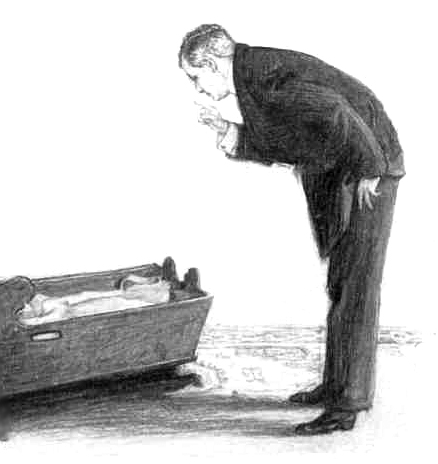 Aches and Pains
Dorsus Dolendus Incunabulis (painful crib-back)
A silent but destructive injury, suffered by both mothers and fathers of fussy little cherubs. This injury occurs when the parent bends repeatedly over a crib or a cradle, rocking or singing or soothing their little sucklings to sleep, spending hours and hours in this uncomfortable posture over the course of the infant's first months. Signs include dull aches and pains in the lower and upper back and a tendency for the injured to walk like a tin-man.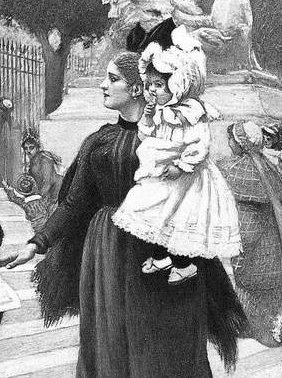 Dorsus Infractus Infantus Adferre (back injury from carrying the baby)
There is a considerable art in carrying an infant comfortably for itself and for the parent. If carried improperly, the parent will grow excessively tired, and the back fatigued. For her own comfort, a good parent will frequently vary this position, by changing from one arm to the other, and sometimes by laying it across both, raising the head a little.
The Common Black Draught is the best cure for either injured back. To make, use the following ingrediants: Infusion of senna (10 drachms); Epsom salts (10 drachms); compound tincture of cardamums, compound spirit of lavender, of each 1 drachm. Families who make black draught in quantity, and wish to preserve it for some time without spoiling, should add about 2 drachms of spirits of hartshorn to each pint of the strained mixture, the use of this drug being to prevent its becoming mouldy.
Bites and Scratches
Infants, while very soft on 99 percent of their surfaces, have incredibly sharp little nails and viciously harsh little teeth. Be wary of ever placing your fingers, ears, or nose anywhere near the infant's mouth, for if you do he could easily snap your finger in two or take a chunk right out of your nose.
Dentition is usually the first serious trouble, bringing with it violent gnashing and vile chewing upon both common surfaces, objects, and human flesh. With dentition comes the first cruel application of the new teeth to the nipple; often the little gremlin finishes his meal and decides to try a wee bit of the wet-nurse for dessert. The nipple may bleed, but applying a mixture of equal parts lime-water and linseed-oil should soothe the agonizing pain of bit nipples, although it will not stop the bleeding.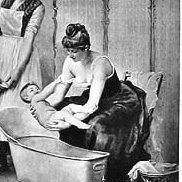 Be also wary of the infant's fingers, and take care to frequently shear the brutally sharp little nails that grow there. An infant's fingers are not only dangerous in their ability to scratch mercilessly, but many infants would not have a qualm about grabbing spectacles or a monocle from a man's face and place them in their germ-filled mouths, muddying the glass with their noxious spittle. After accomplishing this, such a rude lil' imp will often further think nothing of attempting to grab a man's eye-ball itself, or pull away at eye-lids or eye-lashes. It is best to lure an infant's fingers from one's face with the temptation of sweet-meats or a half-sour gherkin.
Be wary of allowing your babies to eat with a fork and knife. They understand these utensils are weapons, and they are not at all afraid to try to use them against you.
If a baby-inflicted scratch or bite is serious, or takes place on some delicate part of the body, such as near the eye, the treatment is very simple in most cases: simply apply a liniment made of finely-scraped chalk and olive-oil, mixed together to about the thickness of cream. Bathing the part bitten with warm turpentine or warm vinegar is also of great use. If the victim feels faint, he should lie quietly on his back, and take a little brandy-and-water, or sal-volatile and water. In a few weeks everything should be fine.
Communicable Diseases & Parasites
Children and infants are generally filthy creatures who spend all manner of time in the dirt among the live-stock riding geese and preparing mud-pies aplenty. Is there any wonder that they return home so worm and parasite-ridden a mother must get out her crocheting needle and inspect each child for hookworms and ticks, lest their filthy, abominable habits result in such a pest finding its way into her own gastronomy? The general symptoms of a vermin infestation are an unnatural craving for food, even after a full meal; costiveness, suddenly followed by the reverse; fetid breath, a livid circle under the eyes, enlarged abdomen, and a strong desire to pick the nose. 
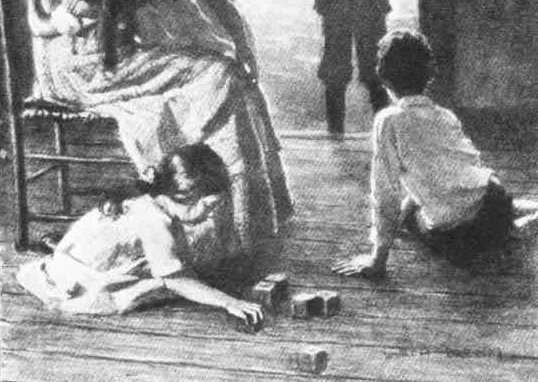 Children bring all manner of foul ailments to their parental hosts which they pick up from their filthy chums while playing hop-scotch and jack-in-the-box in the sandlot. They bring the common cold, influenza, scrumpox, scabies, thrush, pemphigus, scarlet fever, phthiriasis, nits, lice, fleas, pruritis, rubeola, bronze john, bloody sweat, bloody flux, chilblain, grippe, typhoid, blackwater fever, croup, grocer’s itch, cachexy, dock fever, dropsy, quinsy, scarlet rash, scurvy, spongy gums, St. Anthony's fire, hematuria, trench mouth, inanition, quinsy, and black vomit. A parent's best bet for her own safety is to simply quarantine her household by locking all children up in their bed-chambers immediately upon returning from school or from playing stick-ball or doing the jump-rope, and fumigating her children's clothes and rooms with a healthy amount of arsenic and phosphorus.
Psychological Maladies
Among the worst injuries that babies inflict upon their parents are those of the psychological variety. The following is just a brief list of the many psychological torments that parents suffer: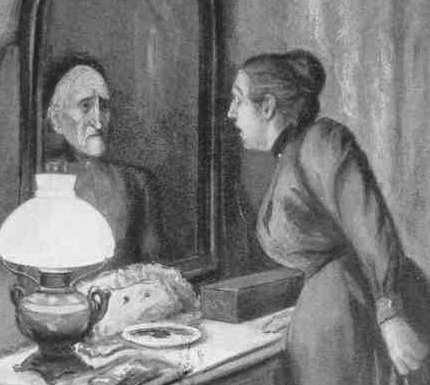 Orbis Maturis (old-guy-in-the-mirror syndrome)
This common parenting malady occurs not long after the first child is born. The parent goes through her days with a certain vision in mind of what she looks like, imagining it to be not so different from how she looked when she was a carefree member of the childfree set, attending cotillions with a full dance card and living a life that did not revolve around scolding the wet-nurse for eating the eel-pie and monitoring the servants' hand-washing of the children's crinoline slips and cambric dresses. Then one day she takes a seat at her vanity and sees the fine lines and wrinkles spreading from the corners of her eyes that no amount of satin powder can cover, and she spends the next 3 hours inspecting her ringlets of hair for the faintest streaks of gray. It is not that mothers and fathers actually grow older upon parenthood, it is simply that the little beelzebubs in the cribs and the prams steal years off the ends of their lives.
Instead of the more traditional 
This pychological disorder is one of the most serious afflictions that tiny babies can inflict upon their parents, it arrives after a combination of all of the injuries, bites, scratches, aches, pains, vermin, viruses, and maladies described above combine with severe sleep deprivation to completely replace loving, doting parents with catatonic, staggering zombies who fall asleep at 8:30 in the evening and then spend the hours when reasonable people should be sleeping pleading with their daughter to sleep, bent over the crib, cursing like grumpy old sailors, coughing, blowing snot from their noses praying that things will be back to normal.
 When last we informed you of the status of the savage ideological fisticuffs going on between our favorite pugilistic pediatricians Dr. Sears v. Dr. Weissbluth, we were poised to give Weissbluth's cry-it-out method a second look and really buckle down and let her cry. The results?
Miserable failure. Weissbluth has hit the mat face first every time we've tried to cry it out. This kid has the endurance of Prefontaine when it comes to crying.
One of the things I loathe most about Weissbluth's theory is the draconian rigor by which he expects his readers to schedule and standardize their babies' sleep patterns, to the extent that parents risk screwing up their babies forever by letting them sleep in slings or in arms or in a car seat or anywhere other than in their own beds at the same times every day. "Screw it up once and he sure as shit won't get into Choate," Weissbluth writes (p. 191). "Screw it up twice and he won't even get into Swarthmore. Three times? You'll be supporting him for twenty-eight years while he gets his MFA from a diploma mill in the Midwest."
Why is it that Attachment Parents are so often portrayed as freaks with their 4-year olds breastfeeding and still riding in hip slings, when it is the strict Weissbluthians who apparently never leave their homes during the first six months of each child's life? That's some serious Boo Radley shit. We just couldn't do that. We had to be out and about and if that meant Juniper took many a nap slumped against my chest in the baby bjorn like that guy who'd get drunk and pass out on our attic steps at parties in our ramshackle college house, so be it.
And with both Wood and I working, Juniper spends a good part of each day in day care, where she takes 2-3 naps a day. They can't let her cry it out in the crib room full of other babies trying to sleep. They rock her and bounce her and sing to her, just like we'd like to do before we set her into her crib for the night. We realized after a few harrowing nights of crying it out that our efforts were being undermined at day care. We were not presenting a unified front, forcing her to cry it out at night for an hour and forty-five minutes, and the next day having her day care provide snuggles and singing and rocking her to sleep like we wanted to, like we oh so wanted to with our hearts dragging across the floor and our ears on the door to the bedroom, analyzing the timbre of her screams and the daggerlike stabs of rollicky, billowing choking and phlegm-heavy coughing, knowing full well that her cheeks were glistening with tears and that her head was full of the vague pain of abandonment and cold. For an hour and forty-five minutes every night we tried, Wood fled outdoors to walk halfway from the Ocean to the Bay and I paced through our one-bedroom apartment, searching for some audial deadspot to escape her screams but I couldn't. It's just too small. Her screams were everywhere. And they didn't stop like Weissbluth said they eventually would. They just never stopped.
We love this lifestyle, this city life a block from the coffee shop and the mom & pop supermarket and the sushi restaurant; we love this apartment. We're not complaining. We chose to live somewhere where extra bedrooms are an unknown luxury. We chose to live underneath an obsessive compulsive South African woman who within 12 hours of my moving in complained about the noise of my guitar, telling me she kept hearing this incessant, unmelodic droning through the floor. She does a freakin' tap dance on the hardwood every time Juniper wakes up during the night, just to let us know she's woken her up too. Because so many of you had so many good things to say about crying it out in the comments to our last post, I'd really wanted to give Weissbluth the full treatment, but I just don't think we can do it with this life we've chosen. Maybe with the next baby. The bottom line is Weissbluth may work great for people with real houses, but it simply can't apply to everyone's situation. What does Weissbluth suggest for people who live in one-room apartments? He suggests you drag your bed into the living room and sleep in there until the baby has cried it out.

[ding, ding] Weissbluth down on a Technical Knockout [okay, I tried to make him look like he was all beat up, but instead he just looks like a one-eyed Muslin cleric with a Selleck-stache] There's just no way we're sleeping in the living room. Let Weissbluth deal with the tap dancing South African upstairs who won't tolerate a full night of crying it out.
So Dr. Sears is sitting down over there in the corner, getting spritzed with water and rubbing a t-bone on his head wounds, cocky, a prizefighter who has come to town and just knocked out the local heavyweight, his barker roaming the crowd to see if there's any burly hero who'd be willing to take Sears on in his weakened state.
Well, we've watched him take on a few new competitors only to knock them down easily in the first round. A friend gave us "The Baby Whisperer" before Juniper was born saying she'd wished she'd had it for her first baby, but I had my doubts right away. Who does this Baby Whisperer woman think she is? What are her credentials? Why would I take parenting advice from a woman who writes her text with the voice of a toothless old hag selling cabbages at a London street market? "Aye, luv, I pull'd this 'ere babbit from tha cabbage patch meself, I did. She's sweet, an ripe, an moist, she is. Aye, luv, you'll ne'er fin' yerself a sweeter, mor' gentle babbit than the uns Tracey Hogg be whisperin' to, no Guv-nuh, 'tis not bloody likely anyhow. I speak in a babbit language only we understan', I do." (p. 23)
I don't mean to speak too ill of the dead (I didn't realize that she died last year until after I'd photoshopped her into that bikini), but Hogg's program just wasn't for us. The scheduling program she calls, "E.A.S.Y"--- (eat, activity, sleep, your time), is actually pretty fucking H.A.R.D. to implement. Hogg talks about "taming" babies like you're actually dealing with wild stallions or cape buffalo or something. We read it, tried it, picked up a few tricks and gave up. We looked into the No Cry Sleep Solution and same thing. Why isn't this baby responding like the hypothetical babies in these books? Why doesn't she fit neatly into someone else's theory? Wood has nearly had it. Coffee is the only thing keeping her sane, triple espressos every morning on her way to work. Juniper is still waking up to feed 3-4 times a night, and waking up for good at 5:30 or 6:00 in the morning. At night Wood falls asleep on the couch early, exhausted. Juniper wakes up a couple times and I go to her from the computer. We've deflated our yoga ball and given up on the bouncing, which we see as a small victory. When she wakes crying, I usually just bend over her crib and sing to her loosely-swaddled form, her tiny voice crying out for a few seconds then merely whimpering as I rhythmically pat her backside to let her know I am there, that I am touching her and that she is safe and warm. I like to think the feel of that rhythm reminds her of that safe place she first knew, her mother's heart and glistening viscera pounding down upon her with that same rhythm, the drifting in and out of my song like the thousand muffled conversations she heard while we touched Wood's belly in the excitement of waiting for her. Eventually I stop the tapping and my voice lowers to a mere whisper, and I sneak away from the crib and back to the computer. Sometimes it only takes few moments to get her to sleep, but sometimes it can take the greater part of an hour.
We can't keep going like this. But we just don't know what to do.
 Things have been a little contentious around our little apartment lately. Some nights I just can't help but feel that there is a pugilistic contest of epic proportions taking place on the squared circle inside our bedroom, the mat inside Juniper's crib. It's a wooden-doweled cage match to the death. No Holds Barred.
Over here in this corner, wearing the blue trunks with the full head of hair and the sizzling pecs is Dr. William Sears, attachment-parenting guru, virile father of eight children, and co-author of "The Baby Book." Many consider Dr. Sears to be this generation's Dr. Spock (some dare call him "America's pediatrician").
And in this corner, in the red trunks, with the steely-gaze of a Republican pundit and the paunch of a moderate beer drinker is Dr. Marc Weissbluth, Dr. Sears' mortal enemy, advocate of the "cry-it-out" or "extinction" sleep solution and author of Cindy Crawford's favorite childrearing book, "Healthy Sleep Habits, Happy Child." Beloved by smug hoards of well-rested parents, Dr. Weissbluth thinks Dr. Sears is, to put it mildly, full of shit.
In our household, we were early enamored with the Sears method. We co-slept with the kid for six months. For those first few harrowing weeks she always slept our arms; she fell asleep with Wood on the couch or with me in the rocking chair. When she cried we did everything we could to stop the crying. I walked her around the block a thousand times. We danced in our living room to the stereo turned up loud. We were known to turn on the vacuum cleaner to distract her from the sound of her own sobbing. And we bounced. We bought a gigantic yoga ball and we bounced and we bounced and we bounced.
Eventually when she fell asleep, either through breastfeeding or through bouncing, we would lay her gently in her co-sleeper and pray we'd get a few hours where one of us didn't have a child in our arms. This rarely happened. More often than not, Wood would end up with a sleeping kid in her arms, on the couch. In the morning the baby would sleep on my chest, my hands keeping her arms from flailing while I tried to salvage some last moments of sleep.
In time she would sleep longer on her own in the early evening. Still, when she eventually woke screaming we would rush to comfort her, pick her up and start the bouncing or rocking all over again. She always wakes up a few times a night to eat. This has worked out for us okay, and we told ourselves over and over that it would get easier.
But it hasn't. It has only gotten worse.
She wakes up four or five times a night now, and it is getting harder and harder to put her back down. The 4:30 wakeup is the worse. We decided a few days ago that we were going to look at Dr. Weissbluth's book again. I had originally dismissed it as poorly-written and harsh. I looked to see what Dr. Sears had to say about Weissbluth and his method:
"The style of parenting called self-soothing, which is creeping into the "Let's have babies conveniently" mind-set, emphasizes techniques of teaching babies how to comfort themselves---by leaving them alone or setting them up to devise their own methods--- rather than allowing babies to rely on mother or father. On the surface this sounds so convenient and liberating, but watch out for shortcuts, especially in nighttime parenting. This school of thought ignores a basic principle of infant development: A need that is filled in early infancy goes away; a need that is not filled never completely goes away but recurs later in 'diseases of detachment' – aggression, anger, distancing or withdrawal, and discipline problems.” – William Sears, ‘The Baby Book’
KAPOW!
Jesus, could we really take that risk? If we let her cry it out so we can start enjoying evenings with white russians and DVDs that we don't have to pause every half hour when she starts crying, would we be fating her to an adolescence spent smoking cigarettes out behind the alternative high school? Would it make her harsh and mean? Would it make her not-so-sweet?
Sears originally came out swinging. I have never been able to shake those words. They haunt me. But as time went on, I grew less than impressed with the results of his methods. So I went to Dr. Weissbluth to see what he had to say about attachment parenting:
"Some parents bend over backward to appease their child. 'I want to avoid the strict parenting I received.' This may lead to the absence of limits. Parents who are too sensitive to their child's needs risk enabling their child to become too dependent on their caretaker. These children do not learn to read their own signals and require an adult to do it for them. Children crave order, and setting limits is one way to that end. Harsh commands, physical punishment, or power assertion produces children who have higher levels of guilt and exhibit parent-pleasing behavior. It is even worse when, after becoming too harsh, spanking too hard, or letting your child cry too long, you quickly rush to hug your child. This sends a very mixed message to your child. Your child starts to think that crying is what you need to do to be hugged." Marc Weissbluth, 'Healthy Sleep Habits, Happy Child.'
BLAM! ZONK! POW!
Motherfucker! Weissbluth comes out swinging. So what you're telling me is that if I don't let her cry it out, and I go to her and comfort her every time she cries, I'm actually teaching her that she needs to cry in order to get me to come to her and show her that I love her? And that over time this is going to create a myriad of social and emotional ills if not immediately rectified? So, Dr. Weissbluth, if I don't follow your advice, my little girl is going to turn into an emotionally-needy attention-starved drama queen? Does that mean I'm going to have to go to bad high school performances of Oklahoma! and Brigadoon in fifteen years? Cripes.
The choice is between that and a surly, withdrawn rebel? What kind of choice is that?
Dr. Sears started the round extremely strong, scoring lots of early points, keeping Weissbluth on the defensive until just a few days ago. Wood, exhausted, told me she was ready to start extinction. Sears will tire you out, man. I'm just waiting for my hair to start falling out and for powder-blue drawstring pants like my dad wears to start looking really comfortable. This baby is turning me into an old man. Extinction has been inconceivable for seven months. We've got an old lady who lives in the apartment above us who stomps on the floor every time we make any noise. There's nowhere we can go in our apartment to escape the crying. Wood's hormones can't take it, so she has been going out for long walks while I sit and listen to the baby choke and wail. It took almost an hour the first night before she finally gave up. It was about 40 minutes the next night. We have to swaddle her to keep her from banging a tin cup against the bars of her crib and throwing flaming pieces of paper at us. I'm alone tonight (Wood is at a retreat in Monterey, sleeping well, hopefully). Juniper went down while feeding so I haven't had to let her cry it out.
And I don't know what I'm going to do when she wakes up.
[Ding Ding] End of Round One.
Weissbluth is now on the offensive. We'll let you know how he's faring in a few days.