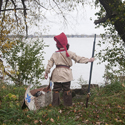
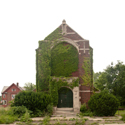
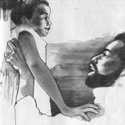
There is a school that Juniper and I walk past almost every day. "Where are the big kids?" she asks every time. Sometimes we see them inside their classrooms, sometimes some of them even come to the window to see us, a tangle of smiles and waving hands pressed up against the glass. "Someday, Juney will go to school," she says. "Someday she will be a big kid." I nod.
"Someday," I say.
After we see our neighbor's new baby, she always asks me to hold her like I did when she was that little. I cradle and rock her against my chest, and she pretends to cry but bursts out in giggles instead. She tells me that she is not a baby. She is a big girl. She shows me this by riding her tricycle in the park: "Juney is a big girl now," she says, "She has her own bike." She puts her size-five shoes against the pedals and pushes so hard I can't believe the trike doesn't go flying out from under her from the force of her sheer determination. The trike doesn't move at all, of course, but then it does, and she screams with surprise and glee. She doesn't notice me bent down, my forefinger pushing ever so slightly on the seat behind her. All she sees is the sidewalk ahead.
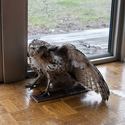
"J-U-N-E-Y, that's Juney!" she shouts as her trike runs over the words we wrote the previous day in chalk on the sidewalk. "M-A-M-A, that's Mama!" and: "M-A-M-A, that's Dada!" Then we sit in the grass and she tells me about an owl named Luther who comes to her window at night.
"No Dada, I can do it all by myself," is her new refrain. She usually can't, but I like to let her think she can. We look at photo albums filled with pictures I took of her when she was first born. "What's Juney doing there?" she asks. I tell her she didn't do much then, not like she does now. Still, she asks me for stories about when she was a baby. I tell her about how much she cried, about how we would hold her and dance with her and bounce on the ball until she fell asleep so warm against us. I tell her that her first word was ball. I tell her she used to see the moon in the sky and call it ball. This fascinates her. "What's the moon's name?" she asks, and I tell her the moon's name is Luna. "What was my second word?" she asks, but I am so confused about where she learned to use the word second properly that I cannot remember that her second word was light. She still weighs less than 25 pounds; I still have never used a stroller with her. She still sits in the crook of my arm whenever we walk. I have never had biceps like this in my life. They make Wood purr. But that is just a fringe benefit. I walk with Juniper like that so we can talk.
When it's almost time for her to nap, we dance. First we dance to fast songs and she shakes her head side-to-side and runs wildly in place and in circles. Then we listen to soft songs and she puts her sweaty forehead against my shoulder, and laughs when I dip her. She pretends to read me books before I put her under the covers and sing to her. One of the best parts about staying home is there's no one around to make fun of how I dance and sing. I make up songs about Juney turning into an owl and flying away with the other owls but she looks down and sees her Mama and her Dada and she flies back down to stay with them a while longer but someday she will fly away. When she wakes up from her nap she wants to be held quietly for awhile.
My time home with Juniper recently eclipsed the amount of time Wood spent at home before we left San Francisco. For me there is no imminent move, no endgame, no job prospects or any real interest in returning to the world of work. Some days I might be out in the mid-morning sunshine, in some park or the zoo or maybe inside a museum if it's raining, and I think, Wow, this is my job. Juniper and I just spent two-and-a-half hours the other day building a sandcastle so big she could hide inside it, and the same thought occurred to me. I am so damn lucky.
Here I am, freshly-30-years old, a parent of a two-year old. I should be burdened by the heft of parental responsibility. I should be losing my hair and starting college-savings plans. I should be working hard in some office somewhere, not sitting around playing all day. That's not just my own father's voice talking, but some deeply-ingrained cultural imperative. Men work. They provide. They put meat on the table. They lose their hair from all the stress. Men have ambition. They seek power. They don't consider a 4-mile jog and an enormous sandcastle to be acceptable accomplishments for a weekday. Obviously, I've learned not to be seduced by this way of thinking. But the guilt that I feel for living like this does accomplish one thing: most of the time it prevents me from complaining. Some men don't just feel like they should be providing; they actually need to be. They have no alternative. That makes me feel very lucky, even when my greatest accomplishment on any given day is nothing more than successfully cleaning crayon off a wall. Even when my child is on her third temper tantrum of the morning I feel fortunate to get to do what I do. It is a privilege that I wish every dad in the world could have if he wants it.
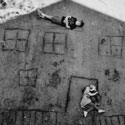
 Stanko Abadzic, in Prague.
For the Memorial Day weekend, Dutch and I set only one goal: to sleep under a different roof from Juniper for the first time in her life.
Originally we wanted to go to New York or Chicago, but in the end we decided not to put that many miles between us and what we were pretty sure was going to be a screaming, hysterical toddler and a grandmother who figured she knew better than we did how to put our kid down for the night. The last time one of her grandmothers attempted to put her to bed, Dutch ended up driving home from my 10th-year high school reunion to find my mother bouncing Juniper on a yoga ball and sweating like Robin Williams at a Russian Schvitz. So we decided to play it safe and stay close to where Juniper would be sleeping---only about eleven miles away. It was more of a theoretical than real vacation.
After dropping Juniper off with my mom, we drove down the Blue Star highway to Saugatuck, a small vacation town on the Kalamazoo River with quaint shops and three bed and breakfasts for every winter resident of the town. We didn't stay in any of them. The ones that weren't all booked for the weekend were $300 a night and promised lovely rooms filled with carefully-chosen antiques and orange marmalade handmade by the cross-dressing septuagenarians who ran the place. I used to be a cocktail waitress in Saugatuck, and never have I seen so many men who looked like Nathan Lane (as the "mom") from The Birdcage and Robin Williams' hairy-armed Mrs. Doubtfire out on dates.
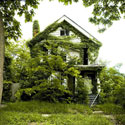
Instead of a B & B, we stayed here: It was a few miles out of town situated between two trailer parks. Even though Dutch is a cheap bastard who loves just about anything from the 1950s, he was so skeeved out by the looks of this place that he made me get out of the car and peer into the windows of one of the rooms before agreeing to spend the night there. He kept muttering, "Alfred Hitchcock sure did ruin these little motels for everyone. They should have formed an organization and sued his fat British ass."
 After convincing him that it wasn't Norman Bates but a nice Indian family at the front desk, we checked in. Then we drove back into town to have dinner. Here's how things went:
6:45: Enter Hoopdee Scootee. Walk around the store, gazing at penis shaped pasta and pink flamingo necklaces and ties made entirely out of rhinestones. Tell Dutch how much I loved this store in junior high, and how naughty I felt walking around it, but how it was always the first place my friends and I went. We bought a birthday card for Dutch's slightly-homophobic dad featuring about ten guys and their naked butts.
7:10: Walk all two streets of Saugatuck, scrutinizing the menu of every single restaurant. This is something Dutch and I have done whenever we traveled. We walked around the entire city of Rome looking at restaurant menus before we found one that satisfied him. It used to drive me crazy, but it happens so infrequently now that we have Juniper that I almost found it endearing. The one place we agreed on had an hour wait, so we put our names on the list and walked the two streets for another hour.
8:02: After being seated in the restaurant, we notice that our table has a tiny cup of crayons on it, and this makes us miss Juniper. Wonder aloud why we left her in the first place. Sappily agree how sweet she is. We order beers and dinner, and I check my cell phone every few minutes to see if I have service in the restaurant. I don't. Wonder continuously if my mom is trying to call.
9:00: Finish dinner, go outside where I finally have cell phone service again. The phone notifies me of a new voicemail. I listen to the message -- it's my mom, she sounds exhausted. She asks us to come home.
9:01: Call my mom. She says Juniper is "very distraught" and has been asking for us for 45 minutes, beginning when my mom tried to get her to go to bed. I ask her what she's doing now, since I can't hear any crying, and my mom says she's sitting with them watching Emeril. I have my mom put Juniper on the phone, and she says: "Hi Mama! What are you doing?" without a trace of tears or sadness in her voice. "Mom," I say, "Try again. She is fine. You're getting played. I'll call back in a half an hour."
9:05: Talk with Dutch about what my mom should do. He develops elaborate theories and strategies and encourages me to call my mom and tell her about them. I don't. We wait and walk and stew by the river and pass what seems like hundreds of little kids in strollers with their parents. Why didn't we just bring our little kid with us? Agree we should have gone someplace where toddlers are forbidden. Like a strip club. Or a gay bar. We end up in the bar where I used to work. They scrutinize our IDs. That makes the whole night worthwhile.
10:00: My mom calls again. Juniper is now asleep. After a boring Iron Chef re-run, she asked to go to bed, and fell asleep right away.
10:01: The night is young! Our kid is finally sleeping! Time for the all-night party to begin! We get in the car and drive to the liquor store. Remembering my love of blue drinks, I take a fancy to this and insist we bring it back to the hotel: 10:45: Take three sips, gag. Fall asleep a few minutes later.
9:17 a.m., the next day: Dutch wakes me up to tell me how late we slept. Success! Maybe next time we'll drive all twenty miles up to Grand Haven.
It was recently announced that the old Fort Shelby Hotel, one of downtown Detroit's important abandoned skyscrapers, is going to be saved through renovation and reuse as a modern hotel facility. It will have 204 suites, 63 upscale apartments, and cost $82 million. The hotel hasn't been occupied since 1974. This kind of news is like a gasp of air from the lungs of a body already rolled to the morgue. It's a big deal.
In August 1967, my dad went to Detroit for the first time without his parents. He boarded a bus in front of the Kalamazoo Armory at about 8:00 p.m. and took the two-and-a-half hour trip across the state with a few dozen kids who'd all recently turned eighteen. My dad's low number had been read and he rode that bus with his draft card in his hand. Most of the other guys on the bus had already graduated high school and they had packed their bags not knowing whether they would be going right to their induction; they said goodbyes to parents outside the armory not sure of the next time they would see them, or if there would be any reunion at all that didn't involve a flag-draped coffin and a plain white cross off in a field somewhere. My dad was lucky: he still had another year of high school to go. The friends he'd grown up with that had already graduated sat next to him on the bus in somber thought all the way to Detroit, where they were to be weighed and measured and prodded to the army's satisfaction before getting shipped off to basic training. The bus was full of black kids, white kids, working class kids; all of them, for whatever reason, weren't headed for college. Dad understood his to be a temporary deferment; he had no college plans of his own and knew he would get hauled away as soon as he tossed his cap into the air the following June. Still, it must have been something to keep him sane on that long bus ride. They pulled up to the Hotel Fort Shelby at close to midnight.
By that night forty years ago, the hotel had already seen years of decline. 22,000 white people had fled the city of Detroit in 1966, and they and the many tens of thousands who'd fled before them took tax revenues, jobs, property values, property taxes, industry, and, in Coleman Young's famous words, "plain damn money" with them. That money, like the white people themselves, was resettling out in the suburbs in newer hotels, conference facilities, banks, shopping centers, office complexes, and factories built in places where middle class whites wouldn't have to interact with middle class or poor blacks. Walls were built to separate white suburbs and the black city. And all of this started before July 23, 1967, when Detroit's white police force raided a blind pig on what is now Rosa Parks Boulevard, expecting to arrest a handful of patrons. Instead they found 82 people celebrating the return of two Detroiters from Vietnam. They arrested everyone, and the resulting furor erupted into the most violent and deadly riots in modern American history. After thousands of federal troops finally quelled the looting and rioting, at least forty-three people were dead (most of them black), 467 were injured, hundreds of businesses had been looted, and more than 2,000 buildings had been burned to the ground. The riots received international attention. Alongside footage of the war in Vietnam, all over the world people watched soldiers in combat in Detroit, images of burning buildings, and M48 tanks rolling through the streets of a major American city, with the retort of sniper and machine gun fire. This cemented in the minds of millions an image of Detroit that remains to this day. 67,000 white people left the city in 1967. 80,000 followed them the next year. They just kept leaving.
In this context, I suppose it makes sense that the beautiful old Fort Shelby hotel would make an agreement to temporarily house thousands of drafted teenagers from across Michigan as they underwent physicals before getting shipped off to Vietnam. Who would book a conference in burning streets? Who would come here for vacation? Dad says the hotel was already a dump when they arrived, but it was far worse when they left. According to his story, those days in early August 1967 may have accelerated the Fort Shelby's inevitable decline as much as the 12th Street riots did for the city itself. The city those draftees rode into was still smoldering from the riots; the streets were empty and the salvageable buildings had not yet been boarded up. Here were boys about to go off to fight a war, seeing a city much like the ones their fathers saw in Europe at the end of their war: chimneys rising out of rubble, piles of brick and crumbling plaster; children wandering through blocks emptied of all their previous density. This was a part of the America they were going to be fighting for halfway around the world: an America that kept an entire race of people on slow simmer. Boys from Grosse Pointe might go off to East Lansing or Ann Arbor, but not Saigon; even rich kids without college deferments knew to provide the draft board with letters from sympathetic psychologists or physicians that would exempt them from service. Either way, they weren't at the Fort Shelby that muggy night, waiting for men who would sacrifice their flesh for some high purpose to decide their fate.
As they arrived they were told to bunk four in a room. Dad described to me the bedlam of the hotel's hallways. Room doors stood open while the boys inside rolled joints and discussed ways to fake various medical conditions the following morning. One kid insisted that sleeping with bars of soap in his armpits would ensure a high blood pressure reading during the physical. Another claimed pretending not to be able to piss when asked to provide a urine sample would work. Still others advocated feigning homosexuality or mental retardation. Things got really crazy when three entire floors of the hotel were flooded by guys messing with the fire hoses. Then they started throwing ashtrays through the windows and destroying the furniture. Almost everyone was drunk. Not everyone was crying, but they all managed to convey that sentiment one way or another. What could anyone have done to them? What worse punishment for these boys could there be than the fate already decided for them? Unable to sleep, my dad left the debauchery of the hotel and walked down to the river. Everywhere he looked there were other somnambulists of the draft, wandering the night in a city still reeling from battles in its own streets, walking along the river and contemplating the skyline of Windsor so close. Dad wandered like that all night.
Despite the riots, there were more buildings then. But my father, young and burdened by ancient thoughts, would have passed under and noticed some of the same ones here now: the Penobscot Building, the Guardian's deco pomp, everywhere the grandiloquent copper shadow of the Book Tower. I like to think of my dad walking these streets, ruminating hard on what fate his life would bring not far from the house where his son would one day raise his granddaughter. I myself have walked alone all night, but never burdened by thoughts that serious. I did it when I first moved to Dublin and knew no one and had nowhere to stay. I have walked alone all night in Manhattan. San Francisco. London. But I have never done it in Detroit. I try to tell myself it's more dangerous now than it was then, but my father did it while the city still smelled like hot charcoal in the rain.
At 5:00 a.m. the following morning, the temporary residents of the Fort Shelby Hotel were bussed off to the Armed Forces Entrance and Examination Station at old Fort Wayne for their physicals. My dad hadn't slept at all, but he says he was in far better shape than many of the other guys who were still so drunk they could hardly walk. When they arrived at the station, they were told to strip and put their clothes in baskets lined up against one wall of a large room. The way my dad describes it seems almost improbable: thousands of men wearing nothing but their socks and shoes lined up like cattle at a slaughterhouse, trudging from station to station, turning and coughing at one and pissing in a cup at another. In the room where they checked his blood pressure, the doctors asked my father to step aside and checked it again a few minutes later. Without telling him a thing, they ordered him to lie down on a cot in full view of the line of boys waiting to get their pressure checked. My naked dad sat there for an hour while the line of naked boys snaked around him, and when they checked his blood pressure again he could tell they were not happy. They told him they thought it was "white coat hypertension" and ordered him to spend another night at the Fort Shelby and come back for another physical the following morning.
He was crushed. When he got back to the hotel it was in worse shape than he'd left it the night before. The furniture in the room he'd been assigned was all broken. There was piss and vomit in the hallways. He spent the day walking around what he remembers as empty streets. Down by the river the draftees congregated, still contemplating Canada. But to working class kids without money or connections, the proximity of that welcoming foreign shore so close was just torture. Dad spent that night sleeping in the lobby of the Fort Shelby. He was too scared to go up to his assigned room.
The next morning, it was the same drill: 5 o'clock bus ride to Fort Wayne, clothes in a basket, standing in line wearing nothing but tube socks and sneakers. Some of his buddies had been classified 1-A and were already sent away to begin the induction process. Dad still had a Class I-S deferment because he hadn't graduated high school, but after his physical it was a full-blown Class IV-F "not qualified for military service" deferment. The hypertension required a more thorough physical, where he actually removed his shoes and socks, and then the examiners discovered the brutal scar from a few years earlier when he'd cut his foot down to the bone after stepping on a broken root beer bottle in a river. That was a story I'd heard before, about how the back part of his foot was hanging by a thread of flesh and how he'd looked at it and seen the bone inside. His brother rushed back to their house to call 911 and eventually Dad hopped halfway back himself, screaming and holding his foot together until the ambulance arrived. The lesson of that story had always been "be careful where you step," but the severity of the injury instantly disqualified him from military service. Perhaps two days of walking had aggravated the old wound. That night, when they put him on a bus back to Kalamazoo, he knew he would not be going to Vietnam.
He was dropped off in front of the armory at 3:00 in the morning, and rather than call his folks he walked the four miles to his house. My grandmother was sitting there with me listening to Dad tell this story for the first time the other day, and she was shocked to learn he did that. "You could have called," she said.
"I know," he said, but I knew why he hadn't. There is no better time to think than when you're walking late at night. And he had a lot to think about that night. Dad didn't go to Vietnam or to college the next year. He got a job at an auto body shop downtown and a few years later he met my mother. I know the story would be better if he hadn't carelessly stepped on a broken root beer bottle when he was a kid, an injury that did not prevent him from walking miles and miles through the night but might have saved his life. I know this story would have been more interesting if it were all about his adventures in Vietnam, shirtless like a Sheen in the jungle. I know there are plenty of others who have stories from that time more interesting and perhaps, heightened by tragedy. But if some jerk hadn't thrown a broken root beer bottle into a river in 1963, I might not be here. And that boring little detail seems very interesting to me.
 Professional photographers were in our house for over eight hours today, standing under curtains behind giant architectural cameras taking long exposure shots inside our home. Juniper kept asking, "Who's that guy?" about men carrying heavy suitcases full of strobe lights and umbrella lamps and camera equipment that cost more than our house.
After those pictures of our house were featured on Design*Sponge a few weeks ago, we were contacted by the editors of a home magazine that wanted to do a spread on our neighborhood, including the interior of our house. This is a very fancy magazine that has annual design awards for "Best Bathroom Over $100,000" and "Best Bathroom Under $100,000." When they initially asked us, I said, "We wouldn't even win 'Best Bathroom Purchased Entirely with a $200 IKEA Gift Card'" and expressed concern that the art director would find our DIY paint jobs and marker-stained carpets appalling. Still, they said they were interested.
The thing is, the photos that led them here showed only four rooms of our house, and only six or seven walls of those four rooms. And I have a confession to make: behind the camera in every one of those shots was a pile of dirty clothes and other crap, and walls covered in wallpaper. Middle-aged-cat-lady wallpaper. There were entire rooms left out because they were hideous, like the bathroom with blood-red painted wallpaper that made you feel like you were peeing inside a giant, beating human heart. Because we didn't know what the magazine people wanted to take pictures of, we took it upon ourselves to get everything done before they got here, including stripping all the wallpaper and re-plastering the walls in the evil blood-red bathroom.
Taking down middle-aged-cat-lady wallpaper, while certainly frustrating, is also strangely fulfilling, as though exorcising from your home an evil demon who wears sensible shoes and lots of makeup and listens way too intently to gardening shows on NPR. In a way, it was nice to have the photo shoot looming, because it made us work hard and now the house feels done and we are happy with it and we no longer have to deal with a malignant spirit constantly trying to put extra-warm clothes on Juniper and switch the TV channel to Lifetime. "The mystery of the cross commands you!" we shouted. "The blood of the martyrs commands you! This house is ours now! Begone!"
Still, getting shit done these past couple weeks would have been a whole lot easier without a kid who has all these goddamn "needs" during the day, and a dog underfoot making everything even more difficult. One thing that drives me nuts about this dog is how he is always dumping some toy in my lap that he wants me to throw to him. We spend hours playing fetch in the park, but he has a one-track mind and constantly stands in front of me with a toy at my feet while he points and wags his tail and looks at me with eyes that are almost impossible to resist. He doesn't care if you only toss it a few feet, so long as you continue to do so for hours and hours and hours. I have been training him to stop. The only other shitty thing about the dog is that with the onset of 80 plus degree weather, he has started shedding. Everywhere.
Needless to say, I have been doing a lot of vacuuming. Luckily, we have a Dyson. I know it emasculates me to admit this, but I love it. Vacuuming with a Dyson is kind of like being a streetwalker with a heart of gold who gets picked up by Richard Gere in a silver Lotus Esprit. Sure, it's still work. But it could be a whole lot worse.
When we brought home the Dyson, the dog and the kid were terrified of it. They would both shriek and the kid would hop on the dog's back and together they would hightail it off to furthest corner to cover their ears and do breathing exercises until I was done. Juniper is still unable to appreciate the majesty of this vacuum, but the dog has outgrown his fear. He now follows me around the house, dropping his toy directly in the path of the vacuum cleaner, knowing it will get knocked away. He rushes a few feet away to retrieve it, then drops it right back in the Dyson's path.
While the dog did this as I vacuumed before the arrival of the photographers, it suddenly dawned on me that my wife wasn't the only one using James Dyson's masterpiece of root cyclone upright vacuum technology to make me her little bitch.
I took the bus for the first time since we moved to Detroit yesterday. I've always been skeptical of Detroit buses, I guess because everyone acts like there is no public transportation here so I just assumed the giant, hulking vehicles careening down Woodward Avenue didn't really exist, like ghost buses from a different era. Well today, I strapped on a proton pack and stepped aboard a 53 to head from Campus Martius up to New Center.
It turns out that riding buses here is even better than riding MUNI in San Francisco. In San Francisco I was usually stuck sitting next to some generic professional-type listening to his iPod. If I had the chance to eavesdrop on a cell phone conversation, it was usually pretty lame.
Today a large white girl with two scorpion tattoos on her neck sat down next to me. She was drinking one of those energy drinks that comes in a really tall can. Her overall scent seemed to have been made up of several strata of cigarette smoke and different types of inexpensive perfume. Then she answered her phone:
"I'm back, bitch! Yup, back already. . .Damn, I couldn't hack it out there! I am a CITY girl, man. . .No, I CANNOT adjust. . .you are not going to believe this shit: the gas station closed at eight o'clock!. . .What kind of a motherfucking gas station closes at eight o'clock?. . .I am a city girl and I need the streets to be OPEN and I need a fucking gas station. . .I roam these streets all night. . .Maybe if it'd been Inkster or somethin'. . .I was goin' crazy! I was calling all the time to see what's up withchu. . . Okay, so I'm having a party tonight. . .I'm a go to work now and see if I can hussle up a few dollars. . . You see what you can find. . .We gonna blow shit up tonight. . . . Alright. . . in-a-minute."
Apparently "in a minute" is the new "see you soon"? I like it. I think I'm going to start saying that. I also really like the idea that what defines a city girl is access to gas stations at all hours.
Until this girl boarded the bus, I was the only white person on it. And she chose to sit next to me, even though there were other empty seats, and even though we probably had nothing in common except for skin color. It's funny how people do that.
After my seat companion, my next favorite person on the bus was a chatty black man in his sixties. He was wearing a shirt depicting the actual bus we were riding -- a shirt that Dutch also owns. I knew it would make Dutch very happy to hear that non-young non-hipsters share his love of shirts that feature public transportation.
The driver of my bus was awesome. When three teenagers sprinted across Woodward to catch the bus, darting between the speeding cars and then jumping to the front of the line of people waiting to get on, the driver pulled to a stop and slowly rose to his feet. He walked over to the door and opened it himself, putting his hand up to the teenagers. "No," he said, "You clowns are not cutting in front of these folks." After letting everyone else board, the driver stood by the door and lectured the boys for at least five minutes on proper bus etiquette and respect for senior citizens. No one riding the bus minded the delay; instead, the previously loud bus quieted down (even the chatty bus-shirt man stopped talking) so that we could all try to listen to what the bus driver was saying.
I can't think of a profession that is more bad-ass than being a Detroit bus driver. I love this city. I'm taking the bus more often.
Subscribe to: