It was raining on the interstate a week ago, and even the five-foot snowpiles lining the median were melting into greasy, gunpowder-colored sludge. Every few miles the snowmelt revealed a secret: a dead deer emerging from the melt like a tundra-bound mastodon, released to rot in the 60 degree weather. I never give much thought to dead deer on the side of the road; maybe a brief lament for the animal's awkward death or perhaps a thought to the human lives inconvenienced by it. But these deer were different, sitting as they were in the worsening gloop of winter, their once-brown hides now mottled gray yet still perfectly preserved as if they all had been killed that very day.
More than once I've walked into an abandoned building only to find the rotting carcass of a dead dog not far from the door. The feral animals, seeking some dignity at the end of lives that afforded little of it, seem to prefer to die indoors. I have also found dead dogs in vacant lots, and even the most dessicated of these corpses reveals some hint of a breed (such as a tuft of Rottweiler hair). The breeds of dogs whose bodies you find in fields or alleys usually tell you they were dumped there after losing an organized fight. Life in this town isn't easy for its people. You can imagine how hard it is on dogs.
Last night I was out walking our own former Detroit street dog (saved one day before his date with the needle), when we happened on a stray. Pinch-faced and skinny, the wild dog was only-slightly skittish. I ordered Wendell to sit by a tree while I approached: calming and petting it while looking for any sign of ownership. I brought it back to our porch where I fed it and then told it to get lost. I glanced out the window twenty minutes later and the stray was still sitting there, looking at me. The temperature dove into the low twenties last night. I begged my wife to close the blinds. "If it's still out there in the morning, I'll bring it to the shelter." But this morning it was gone.
On one of my first house scouting trips to Detroit, a friend gave me a tour of Belle Isle, the massive island park in the river between the city and Canada. He drove me past a barbed-wire fence enclosing overgrown foliage with a dozen albino deer huddled together. "European fallow deer," he said. "They've lived here for generations. They used to run wild on the island but now they're penned off in the abandoned zoo."
"Abandoned zoo?" I was intrigued.
Detroit does still have an operating zoo. A good one, in fact, built on an island of city-owned land two miles north of the city border, within wealthy Oakland County. But for over a century the city operated a separate facility first known as the Belle Isle Zoo (which opened in 1895---the same year the European deer were introduced to the island) and then the Children's Zoo (starting in 1947). In 2002, disgraced former mayor Kwame Kilpatrick closed the Belle Isle Children's Zoo despite opposition from the City Council, claiming the pressure of the city's $75 million budget deficit. City council overrode his veto and freed up $700,000 to reopen the zoo. In that year's November election 88 percent of Detroit voters approved a nonbinding ballot initiative to reopen it. Kilpatrick ignored both and shuttered the zoo, shipping off the animals and calling the move temporary. "We need to really figure out what we want there," Kilpatrick said. Of course the "temporary" closure became permanent. Kilpatrick used money appropriated for the reopening of the zoo to fund a "Nature Center" on the most remote and unvisited part of the 982-acre island, including $1 million for a brand new enclosure for the island's dwindling herd of 20 fallow deer.
Seven companies submitted bids to build it, and the city building authority (run by the mayor's cousin), selected a company that had never before built an animal enclosure against the bids of several experienced zoo contractors. The first act of the winning bidder was to subcontract the construction to a company owned by the former mayor's longtime best friend (and fellow convicted felon) Bobby Ferguson [source], a man who has benefited from an untold number of similar schemes over the years (to the tune of hundreds of millions in taxpayer dollars). That is how business is done in the city of Detroit. And these are some of the results:


 Miles and miles of perfectly adequate chain link animal enclosures abandoned so the former mayor's friend could pocket $1 million to build one on the opposite side of the island for 20 inbred European deer.
The Belle Isle Zoo has been closed now for over six years. Many people from this area have fond memories of visiting it as children. There were elephants here. Bears. Monkeys. Tigers. Some of the zoo's big cats were rumored to have been rescued from lives guarding Detroit crackhouses. In 1980, the zoo was completely rebuilt to adhere to more modern ideas of natural habitats with a lengthy elevated boardwalk and African-style architectural elements throughout. 22 years later it would all be left to rot:


 Kilpatrick lied about this zoo as effortlessly as he lied about nearly everything during his tenure. He once put forth some cockamamie idea about turning the zoo into an X-Games style park with skateboarding and "zip lines." But that will never happen. It will sit like this until the scrappers find their way in, followed by the graffiti artists and the drunks and vandals, though the place is a block from the island's main police station and not easy to enter (it's a maze of 10-foot barbed-wire fencing) .
I did not go there with any intention to trespass. I often take the dog for hikes in the woods on Belle Isle. Inside of him a wild hunter sits dormant, and it is necessary to occasionally make him feel useful. Earlier this year a pack of wild dogs were harassing us, keeping their distance. They were smaller dogs than the ones that attacked us at the playground years ago, and once we started chasing them they led us right into the abandoned zoo. Inside the zoo, we followed their tracks through a maze of fences and walls. I could see that everything remained much as it had been left. The felid cages still had trees nailed to the walls for the scratching of giant claws. The monkey house sat silent, still smelling slightly of its occupation. The dog loved the smells of the old zoo, rooting around every corner of the cages or the big cat enclosure. He was the Teddy Roosevelt of German Shorthaired Pointers, the Hemingway of birddogs: a big game hunter, sniffing at ghosts.
 It was strange to stand inside the enclosures and look up to where countless people would have watched whatever animal dwelt there.
 Even stranger were the plants growing inside each enclosure, non-native species probably chosen carefully long ago to resemble the flora of wherever the animal was from but not to tempt them into nibbling. Even a simulacrum of wildness, abandoned, will become truly wild given enough time.
 Every building and every enclosure chokes with overgrown plants in the summer. Dead trees have fallen to crush the boardwalk in places. The buildings are mostly intact, filled with snake and spider exhibits, educational displays. Scrapping damage seems light, though I do think the copper is gone. Signs inside the once-heated felid cages still warn KEEPER IN THE YARD.
 A brush in a big cat cage sits next to an empty 40oz.
 An animal transport trailer slowly rots into the ground.
 From their earliest days, we teach our children about wild things. Even as more and more of them grow up in cities or suburbs, seemingly isolated from anything truly wild, we tell them stories and read them books about elephants and bears, monkeys and tigers. When you're a kid, almost all the good books are about these wild things, most anthropomorphized and friendly. To those of us reading these stories, this obsession with the wild might seem pointless or silly. But to a kid these pages are an introduction to our world and its amazing capacity for strangeness and beauty. We take our kids to the zoo---even ignore the unnerving vacant glaze in the eyes of penned polar bears---because we know there is nothing quite so magical to those tiny minds as seeing what was fiction become suddenly so real.
 But in time, of course, every child will see a zoo for what it is: a place where nothing is real, a place where wild animals cannot be wild, where every instinct is curbed by confinement or scheduled feedings.
This place will never be a zoo again. It is home to a pack of wild dogs now. A reclusive badger or two. Red foxes and red squirrels. A bluejay and a cardinal. A mile away, the fallow deer sit in their million-dollar home, but within the zoo I still find a broad-tined antler shed by a buck during his temporary stay. Half buried in the ground, it is already starting to rot.
We take our kids to the zoo and think we're teaching them about wildness, but really we're teaching them about dominion. A lesson in the power of fences. While all the time, along our highways, outside our very windows, wild things are there. Waiting.
In memory, it seems like I was born into an epoch of ice. As my mother waited for her body to signal I was ready to be born, she anxiously watched the snow fill the road outside her house, several feet of it. Six or seven feet, maybe. My father arranged for an ambulance to meet them at the main road a mile away, which was being kept clear by the township plows. He would get her to that ambulance on his snowmobile.
We were always snowed in. Even the old-timers around those parts acknowledged the severity of those winters. "Remember the Blizzard of '77?" they still ask. "How 'bout the Blizzard of '78? '79? '80?" In my memory there were ice storms; neighbors gathering to curse or admire fallen trees with bark encrusted by inches of ice; weeks without power; a room at the Knight's Inn just for the warm shower.
In early December 1982, there was already a lot of snow. Dad started up the engine of his old Polaris in the garage, and the blue fumes sputtered out and clung to my polyester jacket. The snowmobile clattered out to the snowcovered driveway and he idled the engine a while before shutting it off. Then he let me climb all over it, touch the handlebars even. I was Batman. I was Luke Skywalker.
He went to the shed and brought back our best sled, the big orange one that my sister and I could both fit in easily. He took a rope and tied the sled to back of the snowmobile. My mom had made sure we were both dressed up really warm with hats and mittens---scarves even. She sat us down together in the sled, me in the back with my little sister propped up inside my arms. Mom climbed behind my dad on the snowmobile, grabbing him around his waist as that little 440 engine started up again: that puff of carbon monoxide, some traction in the continuous track, and we were off, as slow, probably, as we could go, off into our own Christmas carol. The big black Labrador trotted alongside us.
In a minute or two, we were beyond the sight of our home or the lights of any neighbor. We went up and down hills, through the forests I would spend my childhood exploring and which would one day be torn down to build a subdivision. Around this time the man who owned this land offered to trade it all to my dad for a forty-year-old Ford; he kept the Ford, thinking the land would never be developed anyway. As we slowly cut our way across those hills with jags of snow falling from the shivering hardwoods, I didn't know anyone owned those woods. I had no reason to think they weren't ours.
We reached a hilltop filled with pines and cedars half a mile from our house. My dad, with his chainsaw, balanced himself on the lower branches of a mighty Scotch Pine and began to climb, disappearing into the tree. Before we heard the first rip of the starter cord he yelled out in fearful shock as snow poured down and he lost his balance, nearly falling. The beautiful Snowy Owl he'd disturbed stretched out her wings and flew off to a quieter perch. Undeterred, dad lopped off seven feet of the top of the tree and it tumbled down with a muted crash as the chainsaw and the snowmobile idled.
* * * * *
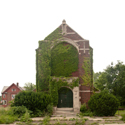
The three-year old in the Radio Flyer crunching along on an inch of freshfallen snow is almost four, she reminds him. She promises to hold on to her baby brother and not let him fall out. The German Shorthaired Pointer trots alongside them. "Don't eat that!" the dad shouts at the dog, who's got someone's discarded Turkey drumstick in his mouth. They pass a playground where swingless chains hang from a metal crossbar; a tennis court he's never seen anyone use, a 140-year-old church that's changed congregations a few times since the German immigrants who built it laid their Teutonic-scripted cornerstone. A homeless man watches the scene from a picnic table. "We can't do this," the dad says before they get to their neighborhood candle/witchcraft store, struggling to pull the wagon and its precious cargo along Detroit's broken sidewalks. He knows the little girl won't walk all the way home, not in this cold, not with the tree in the wagon, the baby in one arm, the wagon's handle in his other hand and the dog eagerly devouring fowl-bones left and right. What was he thinking? Could the dog pull the wagon, maybe if they dangle a chicken wing from a stick in front of him? No. So they turn around.
For three years now they've purchased their Christmas tree from the farmers who spend the month of December living in tiny heated trailers in Eastern Market half a mile from their home, within sight of the urban prairie. As he loads the kids into the car, he thinks about all the time he's spent wandering that prairie. He remembers the patch of cherry tomatoes he found growing wild in the middle of an empty field. He thought of the dogwoods and cherry trees left behind by the people who'd moved away from their neighborhoods, how they still bloom so beautifully in spring. He entertains thoughts of theft: thoughts of looking for an old Scotch Pine, pulling the kids in a sled through the prairie, and lopping off its top with a hacksaw. Silly, he thinks, as he wanders with his son on one arm and his daughter running through a maze of cut trees, looking for one she likes. He hands a Yooper in head-to-toe camouflage a couple of twenties for a tree that smells like Christmas always did. The Yooper loads the smell of Christmas into the trunk.
When they get home, the girl helps her father carry the tree from the car to the house and the dog runs out to greet them. He sniffs the prostrate pine, lifts his hind leg, and marks it to let everyone know just whose tree this is.
I went back to the neighborhood surrounding Jane Cooper School the other day at dusk to get some pictures of just how barren it is.
 That's someone's weave dangling mournfully in the brush.
 Remember that every one of those blocks would, at one time, have been filled with homes. Here is an aerial photo from 1961, followed by the current satellite image of the same general area. A few years ago there were still several houses scattered throughout these streets, but the city spent almost $15 million to clear the people out and prepare the land for industrial development that still hasn't taken place. To the north and west of this area, there are several operating (and even bustling) industrial sites, as seen in the second photo. Still, the transition is shocking:
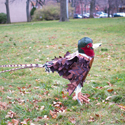
 I was with the dog, and we roused about a dozen pheasants walking through those old blocks and even encountered a two-member dog pack (a BIG rottweiler---I got a distant shot of him for my "wild dogs whom I have known" series even though my hand was trembling like crazy---and a BIG German shepherd). I picked up a stick but they turned out not to be much of a threat, retreating to hide in the brush and bark at us. My German Shorthaired Pointer got so excited every time we roused a pheasant, he sounded like those snakehandling Pentecostals.
Everywhere I bring that dog in Detroit, older black people approach me and say in a Southern drawl, "He's a birddog, huh?" We get to talking and it turns out that decades ago they moved up here from rural North Carolina or someplace like that. They have stories of hunting birds back there with tick-coated dogs like mine, and they all have stories of moving up to Detroit because of the promise of a good job with a decent wage and then they inevitably have stories about how many years they worked on the line before they were laid off. Sometimes these old timers even tell me about children who've moved to Charlotte or Atlanta for jobs. But all we need to do is look around us to know where their own story will end: a place not so different from where it began, a quasi-rural landscape of poverty and hopelessness, where birddogs trill at the stacatto of a pheasant's wings echoing off the ruins.
 When I see it, the sun has nearly set. The memory card inside my camera is almost full. I don't have a tripod with me. But on the ground-floor the windows are wide open, the doors ripped from their hinges.
Jane Cooper Elementary sits gutted in one of the worst parts of one of the most impoverished and dangerous cities in the richest nation in the world. In the late 1990s, Mayor Dennis Archer's office identified this neighborhood as having "more children, more people living in poverty, a greater proportion of high school dropouts, and a larger percentage of violent juvenile offenses than the city as a whole." Which, in Detroit, is saying quite a bit. For several blocks in each direction there are no traces of the neighborhood that once existed here. Most of the houses surrounding the school were torn down for an industrial park that was never built. The school sits alone, a stone monolith on the prairie, still covered in sculptural details and Pewabic tiles.
 Nearly all of the surrounding streets are blocked off from traffic by Jersey walls; other nearby streets are full of trash that has been illegally dumped there or dragged from the school by scrappers. There are piles of old audio-visual equipment stripped of its metal and wires. There are small scars of soot and ash on the concrete where scrappers have built fires to burn away the plastic coating of electrical wiring. An abandoned boat straddles the edge of the street and the school's parking lot.
 I walk over to a playground built a decade ago with hundreds of thousands of dollars in grant money from private and public sources.
 Everything is yellow-orange from the setting sun. I listen for the telltale sound of scrappers working inside of the building: sledgehammers, metal-cutting-saws, yelling. The last few times I drove past they were inside, but now there is no one in the building. The scrappers must have headed off for their miles-long shopping-cart journeys to the nearest after-hours scrapyard (where they will get a fraction of the market value for the metal they've stolen). I can't help myself. I have to go in.


 Later, when I'm safe at home, I try to research the school using the limited resources of the internet, and I find little of substance. It was a civil defense fallout shelter before the school itself and the neighborhood around it looked like they were hit by an actual nuclear blast. Newspaper articles mentioning the school provide only stories of trauma experienced by a few students: three young girls lost their lives in a fire at their home in the neighborhood, a 13-year-old wielding a knife had to be escorted out of the school by police, and an 11-year-old girl was raped in her home by two men she met through a "party line" telephone number passed around at the school. There is an article about the dentist who set up shop in the school, providing free dental care to students who had never been to a dentist, and the optometrist who provided eye exams and free glasses to students who could not see the blackboard. And there are countless mentions of the school in the obituaries of old white people, alumni whose lives ended in the suburbs.
A cursory bit of research at the archives of the public library and I learn that at one time, "pride of home ownership was evident along tree-lined streets of the neighborhood with two-family flats, large brick bungalows, colonials and '50s-style brick ranches." It was a Slovakian enclave then, but this I already knew from the boarded-up "Slovak Hall" along Strong street. The community was served by St. Cyril's church that stood on this prairie as an epic ruin itself for years before it was demolished in 2003. Jane Cooper Elementary was once considered a good school. But so many questions remain. When was it built? Who was Jane Cooper? How many kids passed through its halls from the 1920s until the building was abandoned? The only other mentions of the school in the recent press are the accounts of its closing in 2007.
You read that correctly: the last year of classes at Jane Cooper Elementary was 2006-7. After that, the cash-strapped Detroit Public Schools shut the school down. All the damage in the photographs I took occurred in just a little over one year. I had expected to be overwhelmed by the sense of loss and tragedy for the kids who last walked these halls, the kids whose names remained written on the blackboards, whose graded quizzes and homework and textbooks sat abandoned on the floor. The kids who made this poster:
 But that is an old story, one for the guys bolder and badder than me, the ones who first broke into this place and found the books still stacked neatly in their fine wooden cabinets, the lockers still in the halls, still occupied, perhaps, by forgotten tokens of individual students. By the time I got here, everything is mixed together. Everything is on the floor. Sure, walking around I give some thought thought to the history of the place, to the segregated classes of solidly-middle-class white kids who over time gave way to segregated classes of poor black kids, all within these same halls, in these same classrooms. I thought about the teachers who taught here, the lifers with careers that spanned decades, the idealists who burned out after only a few years.
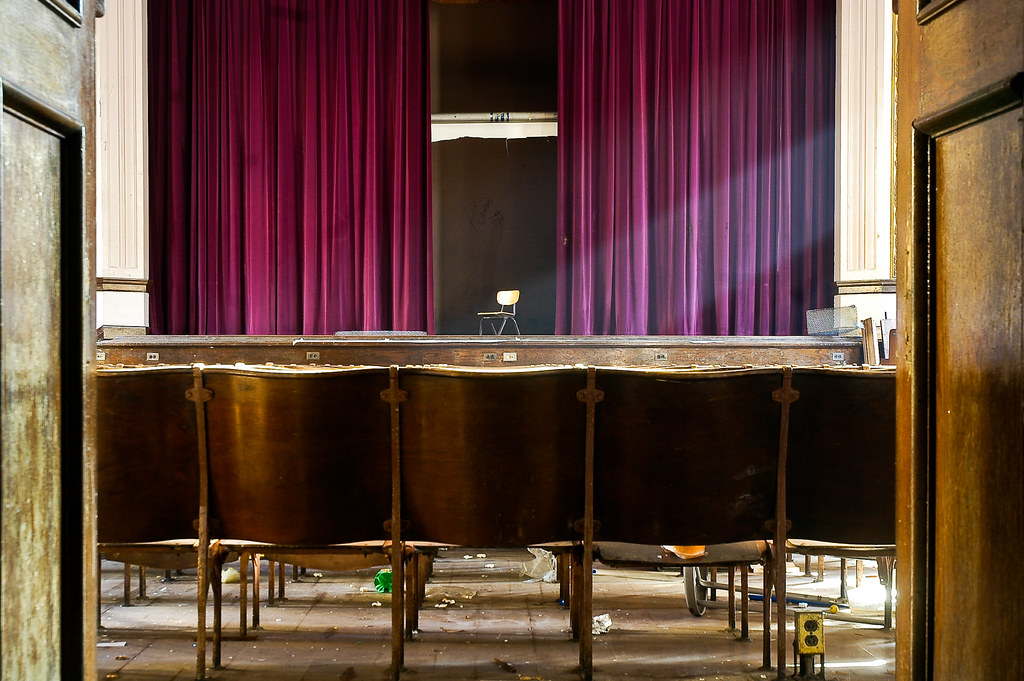
 I could go on and on with this false nostalgia. The story I discovered here no longer belongs to the kids, but to those men with minds bent only towards metal. They came in and took everything of worth. They left textbooks, workbooks, chalkboards, maps. Long gone are the lockers, the pipes, the chairs and desks, the electrical wiring, the pencil sharpeners, the metal bookshelves, the aluminum window panes. Perhaps the most shocking of all was finding the once-lovely central auditorium stripped of its antique seating, the chair bases and backs littering the floor like dragon scales, the metal that held the seats together long ago melted down to feed the world's ravenous appetite for steel. It was impossible for me to cross this room without the clatter echoing through the halls like footsteps of an invading army, even though I was quite alone.
 There will never be classes here again. This building, like so many of the students who passed through it, has no hope. All will be rubble soon. When I showed these photos to my wife she asked, "Don't you wonder if any of the scrappers live by some sort of code---that some of them wouldn't scrap a school, or take playground equipment out of the ground?"
She has never been inside any of these buildings. Anyone who has seen the inside of such a building knows that these are men without honor. The only code they live by is if I don't take this, someone else will. Where I live, men like these are a force of nature, like piranhas in the Amazon; like locusts on the plains; like vultures circling above you as you try to make your way across the sands.
[Related: my follow up visit to the neighborhood, and my photos of the abandoned Detroit Public Schools Book Depository/Roosevelt Warehouse, with posts here and here.]
This summary is not available. Please click here to view the post.
We're on the highway and we pass a funeral procession doing sixty-five miles an hour. My wife tells me she got caught behind one near Eight Mile the other day, with DPD directing traffic and a horse-drawn hearse at the head of a mile-long orange-flagged convoy. "Now I'm normally all for the crematorium or a cardboard box," she says, "But I have to say that was pretty classy. Like having Aretha Franklin sing at the service."
"Seems a bit contrived, though," I added.
"Yeah? I still think it's classy."
"Well I think it'd be classy to dress like Daniel Day Lewis in Gangs of New York, but that ain't ever happening."
I hate even silly conversations like this. I don't ever want to put her in the ground.
* * * * *
My mother called a few weeks ago to tell me she's writing and illustrating a book for the kid. It's all about her ancestors here in Michigan: she received some genealogy research and an old journal from a relative who's since moved on to California. She tells me that the farmhouse built by my grandfather's grandfather's grandfather (or something like that) in 1837 from bricks he made himself sold recently to someone outside the family for the first time. The price? $12,500. "Man," I say. "That's a Hyundai."
"It's in pretty bad shape," she tells me. "Grandpa has no sentimentality at all for the place. He says someone should just tear it down."
* * * * *
We leave the funeral procession far behind and the highway turns blue and soon enough we're driving through the town where my mother was born and raised, an hour or so southwest of Detroit. We hit an area that was countryside when she was a child, but now it's strip malls and sprawl and my child looks out the window at the same chain restaurants and big box stores they built in the countryside outside the town where I was born and raised. I try to remember the directions my mom gave me, turning onto a smaller road with stop signs at intersections where all you see are green corn stalks and the silhouettes of red barns. We pass a township cemetery where my grandfather's people are buried, an aunt or grandmother, I think, some woman whose grave he still keeps neat and flowered. A mile down the road and there's another cemetery, this one older with limestone gravemarkers worn smooth and nameless. I hastily search the headstones for the name of the man who came here in the 1830s while my kids wait impatiently in the car. As we drive away I think again of that first cemetery. My grandfather is in his eighties. He is my last connection to this town. When he is gone, who will put flowers on the grave of this woman? Who will even remember her name?
* * * * *
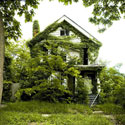
Hardly a block from the second cemetery and I recognize the farmhouse from the etching in the nineteenth-century county gazetteer and the photographs my mom has collected. Built in a Greek revival or federal style, the farmhouse looks exactly like what it was: a home built by a farmer, a man without architectural training but with a talent for craft and handiwork lost today except among highly-trained specialists. How do you even make a brick? How do you lay a fieldstone foundation? My ancestor must have done something right: poorly-built houses don't stand for 171 years. The front has imbalanced fenestration but a nice doorway with columns and a simple pediment. When we arrive the sun is setting through the trees. Aside from the doorway, the only significant architectural feature on the exterior is a simple cornice.
 A knock on the front door goes unanswered. A peek in the windows reveals that no one is living there. Around back, the rear screen door has swing wide and stands open. My mother told me some mentally unhinged distant cousin lived here without running water or electricity until last November. His things (or the things that had been in the house when he moved in) are piled in the old kitchen.
 I consider the hundreds of abandoned buildings I have entered over the years. I have never opened a door that was closed or gone through a window that wasn't already opened. I have never taken anything other than photographs. I walk so softly inside them my heels hardly touch the floor. Of all those buildings, this is the first I've entered that has had any connection to me.
Abandonment always betrays a home with a particular odor of stagnancy. A house needs a moving body inside it to be a home. This abandoned house smells no different than any other. I half expected the blood in my veins to imbue this trespass with more meaning, as though it would allow me to smell an ancestor's soda bread in the stove or hear a strain of some ancient melody in the stillness. Instead giant spiders continue to roll out their cobwebs. They are the only ones who live here now. Unless there are other vermin in hiding.
I continue through the kitchen. On an old cabinet rests a still life of detritus: a pipe, a hacksaw, a broken showerhead. The new owner has already done some work on the place. I shout a greeting from the wooden addition into the brick portion, so as not to startle anyone who might be inside. I expect an answer, or at least an echo, but instead my voice dies as though my mouth were covered in felt. I wander into the main part of the house to find my relation's insane ramblings about medical appointments scrawled in felt pen on the wall of the dining room. I wander over to the front windows and try to picture what this area was like when the bricks were set into mortar back in 1837. All I see is a Currier & Ives lithograph: a bunch of men with Andrew Jackson haircuts or Horace Greeley sideburns wearing waistcoats and inhaling snuff while grumbling about Martin Van Buren and the Coinage Act; a troupe of women with milk pails herding children through waist-high grass. This vision is interrupted by 2008: our dog jumps out of the window of our Volkswagen in the driveway and my daughter chases him around the yard and my wife chases her around with our baby in her arms. Their laughter and shouting sounds good inside these walls.
 This is the front room: the parlor, the room where the caskets of my ancestors would have been set out for wakes before that carriage ride down the road to that final home, that cornice of mound they rest under to this day. I remember the old sampler my mom cherishes that some relative embroidered in a room like this, maybe this very room. It's dated around the time this place was built. I try to picture time being spent here: the kerosene ambiance, the workdays beginning with the sun still on the horizon. I try to picture the room filled with all that mourning, the laughter, all the hardships and pleasures of life. But now it's just an empty room.
Up a narrow set of stairs I find three bedrooms. No closets. No bathrooms, of course: none in the house at all. My mom remembers a working outhouse there. One bedroom has yellow paint peeling on its walls. It is almost cheerful. These are the rooms where babies were made and babies were born and where some babies probably died. These rooms were the lifeblood of this house.

 I look out a window. Juniper is out there by the old corncrib with the bug box her grandparents gave her, catching fireflies. My wife is anxious I think. She doesn't think I should be in here and she's probably right. Here am I, a wannabe Walker Evans, photographing the poetry of bare wooden floors; a wannabe James Agee, communing with spirits who've long since departed, these hardscrabble forebears I romanticize but could never know or even understand.
* * * * *
My grandfather has the soul of an economist. He knows a money pit when he sees one. And who's to say when you're approaching ninety that you aren't entitled to a bit of pragmatism in the face of sentiment over stones and wood and bones. When I saw him this past weekend and mentioned that the stranger who bought the old homestead has already put it back on the market, he warns me against doing something foolish: "It's too far gone, Jim."
* * * * *
Horace wrote, "Romae rus optas; absentem rusticus urbem tollis ad astra levis." Roughly: in Rome you long for the countryside; in the country you sing to the stars of the distant city. I have always romanticized a country life, though I have accepted that my wife's career requires a city. We cannot stop thinking or talking about buying this farmhouse that an ancestor of mine built from bricks he made of clay found in the earth he settled. A hobby farm. A country estate. A vanity of the privileged. My wife pictures a big rustic butcher-block dining table, a quilt draped over the foot of a wrought-iron bed, a wildflower garden. I envision a place to take the kids away from the city to experience the countryside, even just to see stars in the sky. And I am filled with the sentiment of not wanting this family place to become just another ruin. Watching my daughter run freely through that lawn some girl her own age ran through over a century and a half ago, some girl whose blood flows still in her: it made my heart soar to the point where I could almost forget the vision of contractor's bills.
We talk about possibilities on the drive home. "It's nice to dream," I say. In the backseat, sweet Juniper watches the fireflies flit about her little box, and falls asleep.