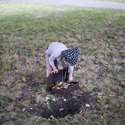
So over the weekend I went back into that elementary school currently being scrapped, headed straight for the library and recovered another pile of books. Shining my flashlight on the shelves I realized that though I'd said the library was intact, in fact someone had gone through and removed most of the newer books. What remained on the shelves were books from the first 6o of the school's 80+ year history. Now I regularly scour thrift stores and used book stores for rare treasures like these; in my zeal I failed to notice the lack of newer books. So either the budget did not allow new books over the past 20 years, or someone moved the newer books to a different school four years ago when the school closed, or someone like me had already gone through and removed the newer books. I dislike the vast majority of kids' books published these days, so to me it felt like they left all the best ones. Others would certainly disagree. You can click on this image to get a big version to see just some of the books I salvaged: There are enough terrifying Nixon-era children's books in there to sustain that blog feature for another year. I only took picture books that my four-year old would enjoy; there are still hundreds---maybe thousands---of books on the shelves of the library. I also took a set a wooden blocks from a classroom with an exterior window being used as an entrance/exit by the scrappers. I am concerned that the elements will quickly ruin everything in that classroom. But I made the mistake of letting the kid see them:
 Also on this trip I took stock of what else remained. Since the last post I have located a non-profit community organization that would love and appreciate some of the items inside, particularly the high-quality Community Playthings wooden kitchen sets (stoves, sinks, refrigerators, washer/dryers), art supplies, books, furniture and computers. I hope to organize an effort to recover some of these items before they get ruined or scrapped. I've already received several e-mails and comments from some folks who went out and done a bit of this themselves over the weekend. If anyone in the area still wants to help, e-mail me (sweetjuniper@gmail.com). I may also put some of the better books on eBay or etsy and donate ALL proceeds to the Georgia Street Community Garden. Mark just e-mailed me to say that due in part to the unsolicited generosity of Sweet Juniper readers, the garden was able to pay the fee to file the paperwork to become a 501(c)(3) non-profit, which will allow greater access to grants and allow donations to be tax-deductible.
I really appreciated all the nice things said in the comments to the last post, but I want to emphasize that I'm just an old vulture in this whole mess. Every day better people than me are working with the kids in this school district: teachers, social workers, volunteers, and even responsible administrators. But they too are victims of the overall system. I am of the same cynical belief of The Wire creator David Simon, who compares institutions like the public school system in Baltimore to Olympian gods in a Greek drama: unstoppable, unquestionable purveyors of tragedy. In Detroit, our institutions are more like a pantheon of even-crueler Scandinavian deities bent wholly towards the destruction of the human spirit, the limitless potential in each child. But even within these institutions, there is always some room for small human triumphs, and I want to commend those working within the system to do good. In the future, I hope to write more about the small triumphs amid all this tragedy.
Look at me. You people are going to turn me into some kind of community activist. Please stop me before I buy a pair of Birkenstocks.
I went back to the neighborhood surrounding Jane Cooper School the other day at dusk to get some pictures of just how barren it is.
 That's someone's weave dangling mournfully in the brush.
 Remember that every one of those blocks would, at one time, have been filled with homes. Here is an aerial photo from 1961, followed by the current satellite image of the same general area. A few years ago there were still several houses scattered throughout these streets, but the city spent almost $15 million to clear the people out and prepare the land for industrial development that still hasn't taken place. To the north and west of this area, there are several operating (and even bustling) industrial sites, as seen in the second photo. Still, the transition is shocking:
 I was with the dog, and we roused about a dozen pheasants walking through those old blocks and even encountered a two-member dog pack (a BIG rottweiler---I got a distant shot of him for my "wild dogs whom I have known" series even though my hand was trembling like crazy---and a BIG German shepherd). I picked up a stick but they turned out not to be much of a threat, retreating to hide in the brush and bark at us. My German Shorthaired Pointer got so excited every time we roused a pheasant, he sounded like those snakehandling Pentecostals.
Everywhere I bring that dog in Detroit, older black people approach me and say in a Southern drawl, "He's a birddog, huh?" We get to talking and it turns out that decades ago they moved up here from rural North Carolina or someplace like that. They have stories of hunting birds back there with tick-coated dogs like mine, and they all have stories of moving up to Detroit because of the promise of a good job with a decent wage and then they inevitably have stories about how many years they worked on the line before they were laid off. Sometimes these old timers even tell me about children who've moved to Charlotte or Atlanta for jobs. But all we need to do is look around us to know where their own story will end: a place not so different from where it began, a quasi-rural landscape of poverty and hopelessness, where birddogs trill at the stacatto of a pheasant's wings echoing off the ruins.
 When I see it, the sun has nearly set. The memory card inside my camera is almost full. I don't have a tripod with me. But on the ground-floor the windows are wide open, the doors ripped from their hinges.
Jane Cooper Elementary sits gutted in one of the worst parts of one of the most impoverished and dangerous cities in the richest nation in the world. In the late 1990s, Mayor Dennis Archer's office identified this neighborhood as having "more children, more people living in poverty, a greater proportion of high school dropouts, and a larger percentage of violent juvenile offenses than the city as a whole." Which, in Detroit, is saying quite a bit. For several blocks in each direction there are no traces of the neighborhood that once existed here. Most of the houses surrounding the school were torn down for an industrial park that was never built. The school sits alone, a stone monolith on the prairie, still covered in sculptural details and Pewabic tiles.
 Nearly all of the surrounding streets are blocked off from traffic by Jersey walls; other nearby streets are full of trash that has been illegally dumped there or dragged from the school by scrappers. There are piles of old audio-visual equipment stripped of its metal and wires. There are small scars of soot and ash on the concrete where scrappers have built fires to burn away the plastic coating of electrical wiring. An abandoned boat straddles the edge of the street and the school's parking lot.
 I walk over to a playground built a decade ago with hundreds of thousands of dollars in grant money from private and public sources.
 Everything is yellow-orange from the setting sun. I listen for the telltale sound of scrappers working inside of the building: sledgehammers, metal-cutting-saws, yelling. The last few times I drove past they were inside, but now there is no one in the building. The scrappers must have headed off for their miles-long shopping-cart journeys to the nearest after-hours scrapyard (where they will get a fraction of the market value for the metal they've stolen). I can't help myself. I have to go in.


 Later, when I'm safe at home, I try to research the school using the limited resources of the internet, and I find little of substance. It was a civil defense fallout shelter before the school itself and the neighborhood around it looked like they were hit by an actual nuclear blast. Newspaper articles mentioning the school provide only stories of trauma experienced by a few students: three young girls lost their lives in a fire at their home in the neighborhood, a 13-year-old wielding a knife had to be escorted out of the school by police, and an 11-year-old girl was raped in her home by two men she met through a "party line" telephone number passed around at the school. There is an article about the dentist who set up shop in the school, providing free dental care to students who had never been to a dentist, and the optometrist who provided eye exams and free glasses to students who could not see the blackboard. And there are countless mentions of the school in the obituaries of old white people, alumni whose lives ended in the suburbs.
A cursory bit of research at the archives of the public library and I learn that at one time, "pride of home ownership was evident along tree-lined streets of the neighborhood with two-family flats, large brick bungalows, colonials and '50s-style brick ranches." It was a Slovakian enclave then, but this I already knew from the boarded-up "Slovak Hall" along Strong street. The community was served by St. Cyril's church that stood on this prairie as an epic ruin itself for years before it was demolished in 2003. Jane Cooper Elementary was once considered a good school. But so many questions remain. When was it built? Who was Jane Cooper? How many kids passed through its halls from the 1920s until the building was abandoned? The only other mentions of the school in the recent press are the accounts of its closing in 2007.
You read that correctly: the last year of classes at Jane Cooper Elementary was 2006-7. After that, the cash-strapped Detroit Public Schools shut the school down. All the damage in the photographs I took occurred in just a little over one year. I had expected to be overwhelmed by the sense of loss and tragedy for the kids who last walked these halls, the kids whose names remained written on the blackboards, whose graded quizzes and homework and textbooks sat abandoned on the floor. The kids who made this poster:
 But that is an old story, one for the guys bolder and badder than me, the ones who first broke into this place and found the books still stacked neatly in their fine wooden cabinets, the lockers still in the halls, still occupied, perhaps, by forgotten tokens of individual students. By the time I got here, everything is mixed together. Everything is on the floor. Sure, walking around I give some thought thought to the history of the place, to the segregated classes of solidly-middle-class white kids who over time gave way to segregated classes of poor black kids, all within these same halls, in these same classrooms. I thought about the teachers who taught here, the lifers with careers that spanned decades, the idealists who burned out after only a few years.
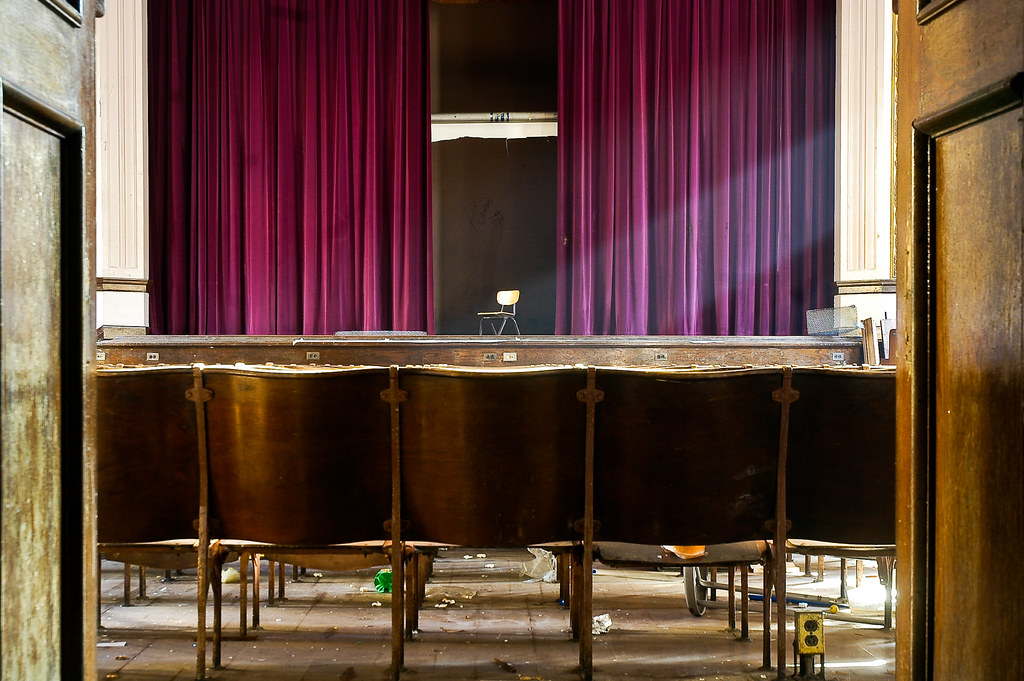
 I could go on and on with this false nostalgia. The story I discovered here no longer belongs to the kids, but to those men with minds bent only towards metal. They came in and took everything of worth. They left textbooks, workbooks, chalkboards, maps. Long gone are the lockers, the pipes, the chairs and desks, the electrical wiring, the pencil sharpeners, the metal bookshelves, the aluminum window panes. Perhaps the most shocking of all was finding the once-lovely central auditorium stripped of its antique seating, the chair bases and backs littering the floor like dragon scales, the metal that held the seats together long ago melted down to feed the world's ravenous appetite for steel. It was impossible for me to cross this room without the clatter echoing through the halls like footsteps of an invading army, even though I was quite alone.
 There will never be classes here again. This building, like so many of the students who passed through it, has no hope. All will be rubble soon. When I showed these photos to my wife she asked, "Don't you wonder if any of the scrappers live by some sort of code---that some of them wouldn't scrap a school, or take playground equipment out of the ground?"
She has never been inside any of these buildings. Anyone who has seen the inside of such a building knows that these are men without honor. The only code they live by is if I don't take this, someone else will. Where I live, men like these are a force of nature, like piranhas in the Amazon; like locusts on the plains; like vultures circling above you as you try to make your way across the sands.
[Related: my follow up visit to the neighborhood, and my photos of the abandoned Detroit Public Schools Book Depository/Roosevelt Warehouse, with posts here and here.]
 Saw a couple of high school friends over the weekend, went to a few hometown bars where we hoped we wouldn't run into anyone else we knew from the dark old days. As we took the first sips of a fourth round of pints, one of us mentioned how none of us ever drank in high school.
"What was wrong with us?"
"What did we do then?"
But we knew. Unlike normal, decent kids who got wasted at some house whenever someone else's parents were in Aspen or Acapulco, we were out causing real trouble: trespassing, jumping from rooftop to rooftop downtown, violating any number of other local ordinances. I spent nights in police stations. I was frisked more than once. "Remember that time you jumped out of Steve's jeep after he drove up that giant sand dune behind the Budweiser plant?" I asked one friend. "We chased you home with Steve shining that police spotlight on you the whole time."
"You assholes said I looked like a Yeti."
But more than anything else, back then we broke into abandoned buildings. There was the ghost town out in the country, the abandoned tuberculosis asylum down by the cemetery, the vacant churches, the shuttered paper mills. We'd bring girls with us sometimes, and they'd stay close, hide their eyes in our shoulders, their frightened breath on our necks. When one of us couldn't round up a girl, we'd go out ahead of time and wait alone for our friends to show up, ready to terrify them with stomping footsteps and rattling chains. I remember the feeling of being alone in those damp, echoing places, the cold silence of the long-vacated morgue, its steel corpse drawers haphazardly opened and closed. I remember the smell of ancient wine spilled from casks stored in the back of the old hotel, where there was an open door facing away from the road and where, terrified, we'd burst out into air that smelled like the mint growing wild in the fields. The ghost town had once boomed providing mint to William Wrigley. The town had died, but we went there to feel alive.
Detroit, with its thousands of abandoned structures, is something of a mecca for kids and adults who still do this sort of thing. There's a whole community of them here, and people come from all over the country to "explore" the city's ruins. In the little I've done since we moved here I haven't found that same adolescent thrill. Maybe because I no longer need to terrify girls to get them to come close to me. Or maybe the whole thing just seems so hackneyed because there are so many people doing it here. My photographs of these buildings seem so clichéd, so easily sentimental. There have been moments where I have been awed, like the eve of this past Thanksgiving, when I finally wandered into the darkness of the Michigan Central Station, a Beaux-Arts masterpiece designed by the same firm as New York's Grand Central, but abandoned to the mercy of the elements, architectural scavengers, vandals, and graffiti taggers. To visit and photograph this building again is something of a cliché in urban exploration, as it ranks high among the greatest modern ruins in the world. It is our Parthenon, our Colosseum. Yet in the stillness of the early evening, with rain dripping everywhere through its tattered roof, and darkness slowly swallowing the faded, almost-unfathomable grandiosity of the waiting room, it was not hard to get lost in the sublime. I was alone in there (as far as I knew), and the darkness and giant Doric columns allowed logic itself to bend. I saw things I will not admit to you. It was terrifying and highly satisfying.
But trespassing across the road, I experienced something else entirely. Because of the response to the photos I put on flickr of the abandoned Detroit Public Schools Book Depository, I went back again to take some more with a better lens in HDR (blending different exposures): This is a building where our deeply-troubled public school system once stored its supplies, and then one day apparently walked away from it all, allowing everything to go to waste. The interior has been ravaged by fires and the supplies that haven't burned have been subjected to 20 years of Michigan weather. To walk around this building transcends the sort of typical ruin-fetishism and "sadness" some get from a beautiful abandoned building. This city's school district is so impoverished that students are not allowed to take their textbooks home to do homework, and many of its administrators are so corrupt that every few months the newspapers have a field day with their scandals, sweetheart-deals, and expensive trips made at the expense of a population of children who can no longer rely on a public education to help lift them from the cycle of violence and poverty that has made Detroit the most dangerous city in America. To walk through this ruin, more than any other, I think, is to obliquely experience the real tragedy of this city; not some sentimental tragedy of brick and plaster, but one of people:

 Pallet after pallet of mid-1980s Houghton-Mifflin textbooks, still unwrapped in their original packaging, seem more telling of our failures than any vacant edifice. The floor is littered with flash cards, workbooks, art paper, pencils, scissors, maps, deflated footballs and frozen tennis balls, reel-to-reel tapes. Almost anything you can think of used in the education of a child during the 1980s is there, much of it charred or rotted beyond recognition. Mushrooms thrive in the damp ashes of workbooks. Ailanthus altissima, the "ghetto palm" grows in a soil made by thousands of books that have burned, and in the pulp of rotted English Textbooks. Everything of any real value has been looted. All that's left is an overwhelming sense of knowledge unlearned and untapped potential. It is almost impossible not to see all this and make some connection between the needless waste of all these educational supplies and the needless loss of so many lives in this city to poverty and violence, though the reality of why these supplies were never used is unclear. *[see update below]* In some breathtakingly-beautiful expression of hope, an anonymous graffiti artist has painted a phoenix-like book rising from the ashes of the third floor.
This building is not far at all from the Michigan Central Station. Its exterior boasts no Corinthian columns, no real ornament to speak of. Unlike the station, it is squat and quite unremarkable. Suburban teens and even adults often ignore it as they regularly break into the station to leave their talentless tags, thrill at the decay, or just stand in awe of the colossal space inside. Their grandparents might have first set foot in Detroit at that station, stepping off trains from back east or down south. It was built with the sort of opulence that signified great promise for anyone who passed through it. Peasants from Poland or Alabama would have been awed by it all, but could hardly have realized that their great-grandchildren would one day leave their names upon its crumbling columns, binding themselves in that way to those same stones as though it were a promise kept.
When I post pictures of Detroit, I am always struck by the way people respond in the comments with a sense of "sadness." The reactions we have to ruins is something that fascinates me, and I'd love to hear more in the comments about how you feel looking at such buildings or even just seeing the photos I post on flickr. Of course, I sometimes share a sense of sadness, but still I wonder: why is it "sad" for a building to be left to decay if there is no one willing to use it? Can decay be something more than sentimental? Can it ever be beautiful? Can it just be respected for what it is, and not further corrupted by our emotions? And what is it that draws us to ruination? Why do some of us find it so compelling? I'd like to believe I am much more saddened by people whose lives fall apart than I am by crumbling stones or plaster. Sadly, social decay is just so much more easy to ignore, and not as prettily exposed with the lens of a camera.
Unless, that is, you stumble upon a warehouse full of abandoned hope. Walking back home from the book depository that day, I stopped to talk to the homeless men who live in Roosevelt Park. They told me they see people like me going into the station every day. I assumed by "like me" they meant bourgeois whites carrying tripods and DSLR cameras. The next time I went, I saw a few dozen more homeless men and women receiving handouts from some mobile charity, directly in the shadow of the train station. Some of them have made homes inside these ruins. They carried bottles covered with paper bags. They seemed almost giddy, happy just to eat something warm. I thought of the lovers in Robert Browning's poem. I thought of the paintings I'd seen earlier that week at the Detroit Institute of Arts, of medieval peasants frolicking amid the ruins of Ancient Rome.
Cows once grazed in the forum. And rich men who are long dead once decorated their walls with scenes not so different from this.
[*update* I have done some research about what actually happened at the book depository/Roosevelt Warehouse and post about it here]
I have just left Juniper screaming for me in a room somewhere. Today is her second day of preschool. After I spend a few minutes in the classroom trying to get her to calm down to a point where she could say something without all the mottled cheeks and snot bubbles and tears and tears and tears, I make my final, confident, I'm-so-proud-of-you goodbye, and one of her classmates says to me, "Where are you going?" and the waterworks start all over again. Her teacher shoos me away and intercepts a screaming Juniper, picking up the tangle of kicking legs and arms reaching for me and I rush out into the hallway, shutting the door behind me and standing against it with the relief of a horror movie heroine after a narrow escape, and as I stop to breathe the entire school echoes with her hollering. Dada. I want my dada. Dada don't leave me. Dada don't go outside. Hold me and keep me nice and safe. Dada hold me and keep me nice and safe. And then it's just screaming. Gargoyles up twenty stories all around downtown Detroit crane their necks away from it; stained-glass windows collapse in deadly, saintly shards; birds are rousted from their nests on Belle Isle, as far south as Canada, and Ohio; Aretha Franklin hears the High C and snaps a Z.
In this moment, all anger and frustration and that unfathomable parental longing to do what feels right even when it will only cause further harm, I bang the back of my head against the door and then scoot away in fear that Juniper might know it's me there, I'm just twisting the knife in deeper and deeper by being there, mere feet away, while she feels so abandoned and so alone. And then I'm crying too, and I'm angry while I'm crying, because she's made me so utterly helpless. Other teachers find me with mottled cheeks standing against the lockers and they say, "You must be the father of the screaming child," and I say, "That's right," with a mixture of shame and pride, shame that I'm crying and shame that I've coddled her and shame that she's not quiet and accepting of her fate like the other kids; and there is also pride, this strange defensive pride I can't explain, a mixture of "how dare someone else have any negative opinion about my kid, she's perfect just like she is," and the sick, selfish pride of being loved and needed so badly that she can hardly tolerate life without me, and perhaps also some pride in the knowledge that this is how I was, how I've always been, a pride at how she cries just like me, her face twisting up while she chokes on words just like I always did whenever I had to part with someone I loved for some reason I didn't understand, a pride that she is turning out to be just like me.
Anger and concern and frustration and helplessness and shame and a curious pride, all this in me as I grip the steering wheel and drive away. I remember some trite condolence: "It's harder on the parent than the kid." Of course she will be okay when I get back there. Of course she will hardly notice I've returned. This cleaving of apronstrings is necessary. This unwelcome helplessness, just another curse of parenthood. This was the first of many such partings, of a lifetime of parting. If I'm lucky, it may never be too easy for her.
We've placed a bid on a house that's perfect for us in downtown Detroit. Wood smartly put the kibosh on my dreams of the Frank Lloyd Wright fixer-upper, and for not much more than the cost of a down payment on a house in San Francisco we hope to soon own our first home in a city that most people don't even like to drive through. I can't say that I blame them. Detroiters are notorious for not heeding traffic signals; you can't assume because your light is green that some guy won't blast through the intersection at 40 mph. When people out here in San Francisco ask me what Detroit is like, I say that while I've never lived there, it feels like it's somewhere between Mad Max and The Road Warrior: chaotic and menacing, but not quite post-apocalyptic.
But I have also been telling people how excited I am to live there, and that I think Detroit is incredibly beautiful.
We have been getting "the face" for awhile now when I say such things; you know, the one where they look like they're smelling a particularly turgid dog fart. It usually accompanies the words: "You're going to raise your daughter there?" The speaker's eyes then dart from side to side, anxious, as though the men in the white lab coats are about to get out of their white vans and rush us with straitjackets to take us to the loony bin. "Have you ever actually been to Detroit?" we've been asked four times.
It's really starting to piss me off, and probably setting me up to reflexively become one hell of an asshole about it. But before I get to that, a slight digression:
Despite my recent accolade as a mommyblogger and my honorary degree from vagina university, I am still a man. That means I am pretty dense about some heavy shit, like all the fucking insecurity and the "judgmentality" among interacting parents (particularly moms). Despite all the shit that went down a few weeks ago and all the veterans of the mommy wars banging their tin cups all over the internet, it didn't really dawn on me until my wife explained it recently: "parenting is a really fucking hard job," she says, "one that certainly makes me insecure. So we all slog through this job wondering if we're doing the right thing and always feeling terrified that we're not, and then when we encounter someone who has done some other thing, made some different decision, we take that insecure energy and turn it into judgmental hate." Now that I fully understand this subtext, I have heard playground interactions and seen blog conflict where all this runs like electric current through every passive (or not-so passive) aggressive comment. It makes sense. For many of us this is the first time in our lives that our every decision affects the future of someone other than ourselves, and that's an enormous, uncomfortable responsibility. I was reading MamaC-Ta's post from a few weeks ago about all the hate she was getting for dressing her kid the way she wants to, and I really started thinking about how all this insecurity and judgment boils down to a relatively simple chiasma:
(1) Parent A makes an intentional values-based decision to do something (i.e. formula feed, co-sleep, cry-it-out, let her baby watch television, leash or spank her kids, or feed them junk food).
(2) Parent B makes an intentional values-based choice not to do the same thing, often creating a false sense of both insecurity and superiority in Parent B, who feels that it takes so much more effort and sacrifice to make the value-based choice she has made for her child.
(3) Parent B resents (and judges) Parent A for making the "easy" choice.
(4) Parent A feels the blatant judgment from Parent B, often creating a sense of guilt or insecurity for making the choice she has made. Parent A now resents (and judges) Parent B.
In any interaction, multiple values-based conflicts may exist at once, creating a tangled web of judgment and insecurity. Nearly every values-based parenting choice exists on a continuum between two dichotomous poles. Any time a parent takes a strong position or makes a particularly "polar" values-based decision (i.e. "No TV! Only wooden toys!" or "TV teaches my babies to read! They learn so much more from their leapfrog toys than they do from wooden blocks!") the judgment just becomes intrinsic to the choice. You really can't win, unless you learn to just accept that judgment and insecurity are a part of this process, and ultimately if you have a strong sense of personal values you just make decisions according to those values and try not to ignite the insecurities in the other side. Easier said than done.
We're learning that one of the most contentious of these values-based choices is the decision about where to raise your children. Despite having known quite a few awesome, successful people who grew up in the city of Detroit, we keep hearing from ordinarily politically-correct liberal people that we simply cannot raise our baby in Detroit. Some list proxy excuses like bad schools, personal safety, and corrupt city government and nonexistent city services to try to convince us that it's the wrong decision. The bottom line is that Detroit is black and for many people that's enough. Does all this judgment add to any insecurity we have about our decision to live in the city? A little, and I've written about it honestly before. Is that insecurity going to stop us? Hell no.
But what it is really threatening to do is make me really resent the people who imply we are making the wrong decision, that we are making the wrong choice and jeopardizing the safety and future of our little girl. I recognize that it's all just part of the chiasma: some judge us as crazy or simply bad parents; others resent us because they assume we think we're better than them. It's the latter that I am most concerned about, probably because our general views are less divergent. I think our decision to live in the city is viewed by those sensitive about living in the suburbs as a rejection of their decision (or sacrifice). In other words, we are choosing to live in a place they perceive as too dangerous to live not because we like danger but because we would never live in a place as lame as the suburbs. And that part is true. Wood and I would never live in the suburbs. But I'm not going to turn this into a "why Dutch doesn't want to live in the suburbs" post. That must be such a tired subject among actual metro Detroiters. I'm just not going to argue about how statistically it's more dangerous to commute for 90 minutes a day on congested highways than it is to live among black people.
When Wood and I were 19 we drove to Canada with Wood's college republican friend and a group of her high school friends who all grew up in Farmington Hills, an affluent exurb of Detroit. In Canada, the drinking age was 19. To get there, though, we had to drive through downtown Detroit. It was late, but some concert must have just ended at Joe Louis Arena and we got stuck in highway gridlock not far from the Detroit/Windsor tunnel. Everyone in all the other cars was black. The tension in our car was palpable. The Farmington girls were terrified. They started talking about the people in the other cars as "they" and "them" and one even went so far as to call them "animals." I couldn't hold it in anymore and I got into a shouting match with her. It was a certain kind of ugliness you don't get to see too much, given how privileged people are taught to be so careful with their words. For the rest of the evening I had a headache and I didn't want to go into any of lame clubs these girls were dancing in, nor did I have any desire to drink. Wood sat with me out in the empty streets of Windsor, her new boyfriend driven to contemplative silence.
It's infinitely tricky to explain why you see beauty in a place where so many others see only ugliness, without also explaining that you see ugliness in the places they find beautiful.
God knows not everyone from the suburbs is like those girls from Farmington Hills. I know plenty of people who grew up in the suburbs who are now living in the city that their parents' generation abandoned. I also know plenty of people who grew up in the suburbs, raise their kids in a streetcar suburb, and are completely awesome. I love how beauty can flourish amid all different kinds of ugliness, how it can overcome its context, whether it be urban blight or suburban sprawl. You are ultimately unique from the circumstances that shape you. You don't have to think the way everyone around you thinks. You are not condemned to be a bad parent just because you had bad parents. You can make values-based decisions and stick by them no matter how many people tell you that you are wrong.
From this bully pulpit I will share some of the beauty I find in a city that so many have told us contains only ugliness. I may share ugliness, too. Like everywhere and everyone, I'm sure it has plenty of both.